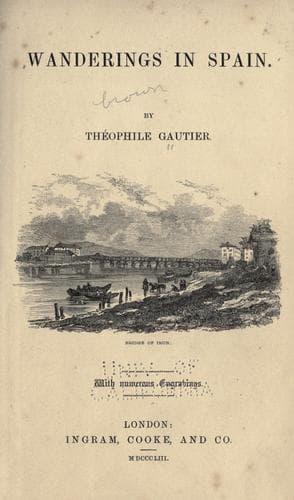
Gautier, Théophile, 1811-1872 -- Travel -- Spain; Spain -- Description and travel; Spain -- Social life and customs -- 19th century
than they are. They most strenuously disavow the Spain of the
Romancero and the Orientals; they almost invariably assert that
they are neither poetical nor picturesque, and their assertion is,
alas! but too well founded. The drama was well played. The Ruy
Gomez of Valladolid was most certainly equal to that of the Rue de
Richelieu, which is not saying a little. As for the Hernani, that
_rebelle empoisonné_, he would have been highly satisfactory, had
he not had the bad taste to dress himself up like the troubadour on
a clock. The Doña Sol was almost as _young_ as Mademoiselle Mars,
without her talent.
The Theatre at Valladolid is of a very pleasing shape, and although
the interior is only decorated with a coat of white paint,
ornamented with cameos on a grey ground, it produces a pretty
effect. The decorator has hit upon the strange fancy of painting
the partitions of the stage-boxes, so as to resemble windows with
spotted muslin curtains, exceedingly well imitated. These windows
have a very singular appearance. The balcony and the front of the
boxes are formed of open-work, which enables the spectator to see
whether the women have small feet and well-made shoes; indeed,
it also enables him to see whether they possess a neat ankle and
well-fitting stocking. This, however, cannot be at all disagreeable
to Spanish women, who are nearly always irreproachable in this
respect. I perceived by a charming _feuilleton_ written by my
literary substitute (for the _Presse_ penetrates even into these
barbarous regions), that the boxes of the new Opéra Comique are
constructed on the same plan.
Beyond Valladolid the character of the country changes, and the
vast heaths recommence. They possess, however, the advantage over
those of Bordeaux of being dotted with clusters of green dwarf
oaks, and fir-trees that spread out more at the top, and somewhat
resemble a parasol in shape. But they are marked by the same
aridity, the same solitude, the same look of desolation. Here and
there are scattered heaps of rubbish, pompously called villages,
which have been burnt and devastated by the various contending
factions; and wandering about among their ruins are seen some few
inhabitants, looking tattered and miserable. The only picturesque
objects are a few petticoats, of a very bright canary colour,
enlivened with embroidery of various hues, representing birds and
flowers.
Public-domain text, read in full here on John Shaqi.
Reviews
Reviews
No reviews yet
Be the first to share your thoughts on this work.
Join the Discussion
Join the discussion
Sign in to leave a comment or review.
Sign InorCreate an account