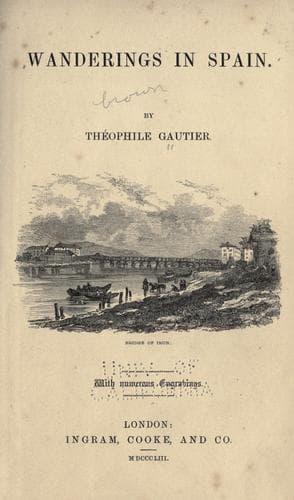
Gautier, Théophile, 1811-1872 -- Travel -- Spain; Spain -- Description and travel; Spain -- Social life and customs -- 19th century
On leaving Olmedo, the country does not offer any great variety
of scenery; the only thing worth notice that I remarked, before
we reached our quarters for the night, was an admirable effect
of sunset. The rays of light illuminated one side of a chain of
very distant mountains, all the details of which stood out with
the greatest clearness, but the portions that were plunged in
shadow were almost invisible; and the sky bore a most saturnine
appearance. Were a painter to transfer this effect exactly to
canvas, he would be accused of exaggeration and inexactitude. On
this occasion the posada was much more Spanish than any we had
hitherto seen. It consisted of an immense stable surrounded by
chambers with whitewashed walls, containing four or five beds
each. The whole place was miserable and naked, but not dirty;
the characteristic and proverbial filth did not yet make its
appearance. In fact, the dining-room contained an incredible
example of sumptuousness in the way of furniture,--namely, a
set of engravings representing the Adventures of Telemachus,
not the charming vignettes with which Célestin Nanteuil and his
friend Baron, have illustrated the history of the wearisome son
of Ulysses, but those horrible coloured daubs with which the Rue
Saint Jacques inundates the whole world. We set off again at two
in the morning, and, as soon as the first streaks of day enabled
me to distinguish the different objects, I beheld a sight that I
shall never forget as long as I live. We had just changed horses
at a village called, I think, Santa Maria de las Nieves, and were
toiling up the first ridges of the chain of mountains we had
to traverse. I almost imagined I was passing through some city
built by the Cyclops. Immense blocks of sandstone, that assumed
all sorts of architectural shapes, rose up on all sides, their
outlines standing out upon the background of the sky like so many
fantastic Towers of Babel. In one place, a flat stone that had
fallen across two other rocks bore a most astonishing resemblance
to the _peulven_ or _dolmen_ of the Druids; further on, a series
of lofty fragments, shaped like the shafts of columns, represented
porticoes and propylæa; in another place, you saw nothing but a
chaos--an ocean of sandstone suddenly frozen when in a state of
the utmost fury. The bluish-grey of these rocks augmented still
more the singularity of the view, while, at every moment, from out
the interstices of the stone there gushed forth, in the shape of
drizzling vapour, or trickled down like tears of crystal, numerous
mountain springs. But what particularly enchanted me was the snow
which had melted and run into the hollows, forming little lakes,
bordered with emerald-coloured grass, or framed in a circle of
silver, composed of snow which had resisted the action of the
sun. Pillars raised at certain distances, and serving to direct
the traveller when the snow throws its perfidious mantle over the
Public-domain text, read in full here on John Shaqi.
Reviews
Reviews
No reviews yet
Be the first to share your thoughts on this work.
Join the Discussion
Join the discussion
Sign in to leave a comment or review.
Sign InorCreate an account