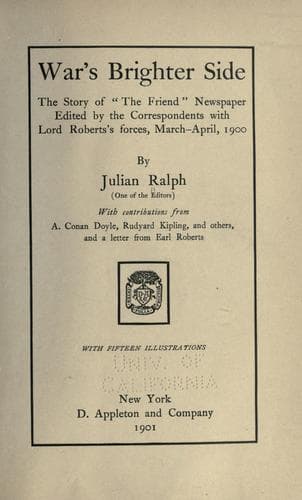
War's Brighter Side: The Story of The Friend Newspaper Edited by the Correspondents with Lord Roberts's Forces, March-April, 1900Ralph, Julian
History
War's Brighter Side: The Story of The Friend Newspaper Edited by the Correspondents with Lord Roberts's Forces, March-April, 1900
Ralph, Julian
Friend (Bloemfontein, South Africa); South African War, 1899-1902 -- Periodicals
We will not forget, Mr. Englishman, and are truly grateful to you,
that you behaved to us with common courtesy, and stood aside to let us
pass; but surely you, the politest of polite men, would not take
credit for that, which should be the birthright of all gentlemen. We
dwell not in times of Sabine sisterhoods, good sir!
And if little Miss Uitlander bathe you in smiles, and lisp pretty
nothings into your much-astonished ear, call but to mind that she
comes from your own "far countree," and has here learned this way of
welcoming the conqueror.
I am no Boadicea, say you. Oh, sir, you mistake grievously. I would
smite you with mine own hands, were I able. Did you perhaps not catch
a glimpse of me in General Cronje's laager, whither I went to share
the danger with my brother, and cheer him in his arduous task?
True it is that homely comfort abounds in our cottages, and should it
not be so? Perhaps there was a time too when your stately sister did
not scorn to keep house, instead of attending theatres, soirees,
musicales, at-homes. Evidently, Miss Uitlander forgot the divine music
of Queen's Hall and Covent Garden, when she crowded to do justice to
the awful and untuneful melodies, to which your English bandsmen
treated her on the Market Square. But you see "It is so long since she
left 'home,' and it is sweet to hear those sounds which come straight
from dear old England." I, sir, stopped my ears with cotton wool (for,
whatever Miss Bloemfontein is, she is musical, and even had I been
pleased to see you, I could never have allowed myself to be tortured
with those fragments of the divine art). Poor Pan! he stood afar on
the topmost steeple of the Dutch Church, and played his pipes and
wept, and had you not been so absorbed in "tripping to your gay
tunes," you might have heard faintly stealing over our ancient towers
"Heeft burghers t'lied der Vrijheid aan," while the organ within our
"piously Presbyterian" edifice echoed the anthem, which was caught up
by the instrument in your exclusively English cathedral, and Miss
Bloemfontein heard the echo and was comforted.
And now, Mr. Englishman, do you fully realise that I am not pleased to
see you, that I hate to have you here; I, a real daughter of the soil?
And if to-morrow I could turn you out, I would do so joyously, while
little Miss Uitlander would stand by, her lovely eyes moist with
grateful tears, and whisper, "That is right," or perhaps push you with
her tiny left hand, while she once more extended her right to my badly
dressed brothers, as they came over the top of the Bloemfontein Hill!
The gulf between the angry past and the still more angry present will
never be bridged, Mr. Englishman. You have made Afrikanderdom by
fighting us, and have awakened in our breasts the knowledge that we
are of another sort than yourselves. Only now, with the "Schwanenlied"
sounding in our ears, do we feel what it is to have a country--to be a
nation!
Public-domain text, read in full here on John Shaqi.
Reviews
Reviews
No reviews yet
Be the first to share your thoughts on this work.
Join the Discussion
Join the discussion
Sign in to leave a comment or review.
Sign InorCreate an account