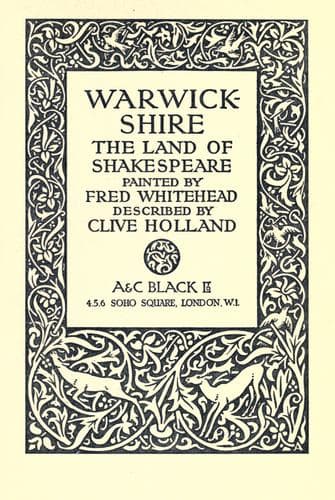
Warwickshire: The Land of ShakespeareHolland, Clive
History
Warwickshire: The Land of Shakespeare
Holland, Clive
Warwickshire (England) -- Description and travel
On the side of the fortifications, opposite the castle, stand the two
impressive though never completed towers known as the Clarence and
Bear Towers, connected by walls of great thickness and solidity. The
first–named was probably commenced by George, Duke of Clarence, brother
of Richard III., who, created Earl of Warwick by Edward IV., projected
vast additions to the castle, which he did not live to carry out;
and the second tower by Richard himself. Opposite these two towers,
extending along the whole river front from Cæsar’s Tower to the Hill
Tower, which stands at the base of Æthelflæd’s mound, is the family
mansion, which, although altered and enlarged at various times since
feudal days, is still a wonderful erection, almost entirely in keeping
with the general aspect of the castle.
In 1770 the entrance porch and the adjoining dining–room, with the
rooms over it in front of the great hall, were built by the then Earl
of Warwick. The apartments, including the state bedroom and the boudoir
and those adjoining the eastern end of the great hall, were in all
probability the work of Sir Fulke Greville about 1605, who at the same
time considerably altered several other parts of the castle.
The ancient fireplace and the dais were situated at the west end of
the hall, and some traces of the former were discovered at the time of
the fire, the chimney still being visible in the south–west angle. Two
doorways, now blocked up, originally led to the kitchen and pantry.
The remaining most noticeable features of this, in many respects,
unique hall are its large modern recessed windows and the fine oak
panelling of the walls, which reaches to a height of about nine feet.
The floor is of white and red marble, brought from the neighbourhood of
Verona, and the remarkable carved stone mantelpiece was brought from
Rome to replace the one destroyed in the fire.
One of the most interesting relics of bygone days amongst the many
which are preserved in the castle is the garrison cooking–pot, a
remarkably fine cauldron made of bell–metal, and capable of containing
over a hundred gallons. This vessel is popularly known as “Guy’s
porridge pot,” and was probably made for the retainers of Sir John
Talbot of Swanington, who died about 1365, for there is an old couplet
quoted by Nichols in his _History of Leicestershire_ running as
follows:—
There is nothing left of Talbot’s name,
But Talbot’s pot and Talbot’s Lane.
It is difficult to say how or when the pot was first brought to
Warwick Castle, but it seems probable that it came into the family
through the marriage of Margaret, daughter of Richard de Beauchamp,
with John Talbot, Earl of Shrewsbury, from whom the Dudleys, Viscounts
Lisle—afterwards created Earls of Warwick—were descended.
Public-domain text, read in full here on John Shaqi.
Reviews
Reviews
No reviews yet
Be the first to share your thoughts on this work.
Join the Discussion
Join the discussion
Sign in to leave a comment or review.
Sign InorCreate an account