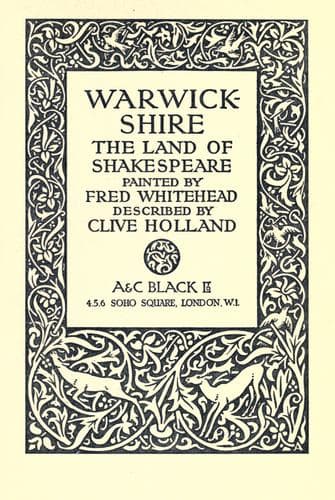
Warwickshire: The Land of ShakespeareHolland, Clive
History
Warwickshire: The Land of Shakespeare
Holland, Clive
Warwickshire (England) -- Description and travel
The mention of Coventry in the Domesday Book, which was written nearly
thirty years later than Leofric’s death, describes the place, even
with its fine monastery, which Leofric founded, as little more than a
small agricultural village, with a population probably of not more than
three hundred to three hundred and fifty souls. Most of the houses at
that far–off period were the merest hovels, without windows; whilst
nearly all the adult inhabitants, save the very aged, were engaged in
agricultural occupations.
By the year 1218, when Henry III. granted a charter for a yearly
fair, lasting eight days, Coventry must of course have grown very
considerably; and it is interesting to know that it was in connection
with this fair in 1677, that the legend of Countess Godiva’s ride
took form as a pageant and procession, the last of which took place
on August 2, 1892. On that occasion the rôle of the self–sacrificing
Countess of ancient times was played by a young lady attired in
fleshings and a short jerkin–like garment of white satin, who also wore
a pair of white kid gloves, a plume, and a flaxen wig!
Sixteen years after the institution of the fair the Franciscans or
Grey Friars founded an establishment in Coventry; and their coming was
followed about ten years later by the Carmelites or White Friars; and
in 1381 there was also a settlement of Carthusians near the south–east
gate. Edward III., in 1344, constituted in the city a Municipal
Corporation by letters patent, and for the better security of Coventry
the inhabitants obtained from the same King permission to levy a
toll towards the expense of fortifying and enclosing the town, to be
commenced twenty–seven years after the grant was obtained. It appears,
however, that the fortifications were commenced in 1355, and the walls
and gates were finished in the time of Richard II. With the walling
in of Coventry the merchants of the period became enriched, the town
flourished and extended, and the beautiful steeple of St. Michael’s
Church was designed and partly finished. In addition to this, the
staple manufacture of clothing was cultivated, and public buildings of
adequate importance began to be constructed.
Public-domain text, read in full here on John Shaqi.
Reviews
Reviews
No reviews yet
Be the first to share your thoughts on this work.
Elsewhere in the archive
Join the Discussion
Join the discussion
Sign in to leave a comment or review.
Sign InorCreate an account