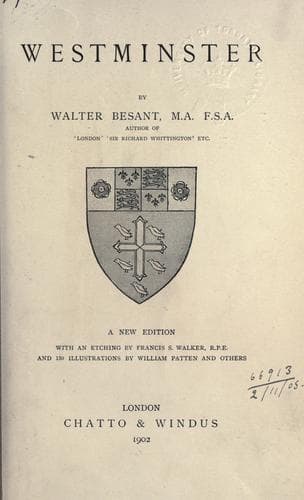
Westminster (London, England) -- Description and travel
The Abbey must not, however, be dismissed without some reference to its
history. There is a history of its buildings, and there is a history of
its people. The architectural history of the Abbey has been written in
many volumes. Briefly, there was a monastery with its church here as
early as the eighth century: this was destroyed by the Danes; then a new
House with its church was founded and the House was rebuilt on a scale
of great magnificence by Edward the Confessor. Next, Henry the Third
resolved to honor Edward the Confessor by pulling down his church and
rebuilding it entirely. This he accomplished as far as the crossing of
the transepts and the nave. The great feature of the new church was now
the Shrine of the Confessor, raised high above the floor of the church
by an artificial mound of earth brought from the Holy Land. St. Peter,
to whom Edward had dedicated the church, was now supplanted by St.
Edward. The nave was continued by Edward the First, who built five bays,
according to Gilbert Scott. The chantry of Henry the Fifth, Henry the
Seventh’s Chapel, and the completion of the western towers by Wren, or
by his pupil Hawksmoor, have been added since the work of King Edward.
As for the domestic buildings of the Abbey, there are still fragments
remaining of the Confessor’s work. But the buildings were in great part
rebuilt by Abbot Litlington toward the end of the fourteenth century.
The Cloisters, the Jerusalem Chamber, the Chapter House, the Abbot’s
dining hall, still remain; while the Cloisters, the Refectory, the
Infirmary cloisters, and fragments of the Chapel of St. Catherine also
show in ruin, more or less complete, the beauty of his work. The history
of a monastery apart from its architecture must be meager. The more
meager it is, the more likely, one feels, is it that the House has
sustained its pristine zeal. To the Benedictine of the ancient rule,
behind his walls, cut off from the outer world, there were no events: he
was buried; the world did not exist for him; the small events of the
Abbey, the death of one Abbot and the election of another; an unexpected
legacy; the building of another chapel; the addition of new carved
stalls to the Abbey church; what else was there to chronicle?
Public-domain text, read in full here on John Shaqi.
Reviews
Reviews
No reviews yet
Be the first to share your thoughts on this work.
Join the Discussion
Join the discussion
Sign in to leave a comment or review.
Sign InorCreate an account