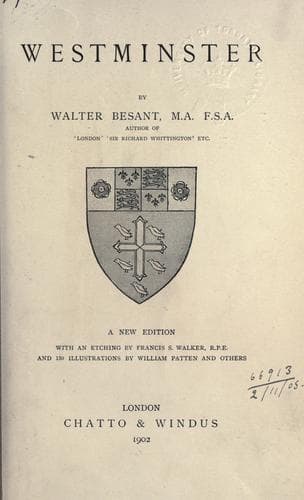
Westminster (London, England) -- Description and travel
“He was a travelling merchant for wool, cheese, and butter, and was
arrested in Flanders for the King’s debts in Bruges, and there were
taken from him £14 1s., for which he sued in the King’s Court at
Westminster at the beginning of August in the thirty-first year, and
then he saw the condition of the Refectory of the Abbey, and saw the
servants bringing in and out silver cups and spoons and mazers. So he
thought how he might obtain some of those goods, as he was so poor on
account of his loss in Flanders, and so he spied about all the parts of
the Abbey. And on the day when the King left the place for Barnes, on
the following night, as he had spied out, he found a ladder at a house
which was near the gate of the Palace toward the Abbey, and put that
ladder to a window of the Chapter House, which he opened and closed by a
cord; and he entered by this cord, and thence he went to the door of the
Refectory, and found it closed with a lock, and he opened it with his
knife and entered, and there he found six silver hanaps in an aumbry
behind the door, and more than thirty silver spoons in another aumbry,
and the mazer hanaps under a bench near together; and he carried them
all away, and closed the door after him without shutting the lock. And
having spent the proceeds by Christmas he thought how he could rob the
King’s Treasury. And as he knew the ways of the Abbey, and where the
Treasury was and how he could get there, he began to set about the
robbery eight days before Christmas with the tools which he provided for
it, viz., two ‘tarrers,’ great and small knives, and other small
‘engines’ of iron, and so was about the breaking open during the night
hours of eight days before Christmas to the quinzain of Easter, when he
first had entry on the night of a Wednesday, the eve of St. Mark (April
24); and all the day of St. Mark he stayed in there and arranged what he
would carry away, which he did the night after, and the night after
that, and the remainder he carried away with him out of the gate behind
the church of St. Margaret, and put it at the foot of the wall beyond
the gate, covering it with earth, and there were there pitchers, cups
with feet and covers. And also he put a great pitcher with stones and a
cup in a certain tomb. Besides he put three pouches full of jewels and
vessels, of which one was ‘hanaps’ entire and in pieces. In another a
great crucifix and jewels, a case of silver with gold spoons. In the
third ‘hanaps,’ nine dishes and saucers, and an image of our Lady in
silver-gilt, and two little pitchers of silver. Besides he took to the
ditch by the mews a pot and a cup of silver. Also he took with him
spoons, saucers, spice dishes of silver, a cup, rings, brooches, stones,
crowns, girdles, and other jewels which were afterwards found with him.
And he says that what he took out of the Treasury he took at once out
of the gate near St. Margaret’s Church, and left nothing behind within
it.”
Public-domain text, read in full here on John Shaqi.
Reviews
Reviews
No reviews yet
Be the first to share your thoughts on this work.
Join the Discussion
Join the discussion
Sign in to leave a comment or review.
Sign InorCreate an account