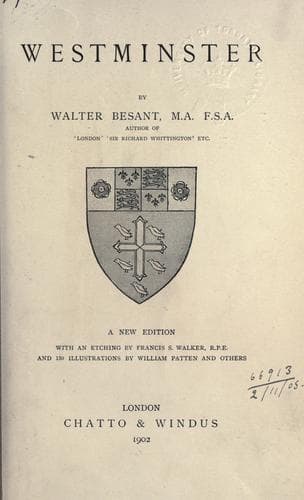
Westminster (London, England) -- Description and travel
There were other reasons for suspecting the Sacrist. He brought one day,
before the discovery, a silver-gilt cup to the Abbot; he found it, he
said, outside St. Margaret’s Church. It was debated whether the Abbot
could rightly keep the cup thus found within the precincts. Where did
the Sacrist get that cup? Did he give it up in fear of having it
discovered in his possession? William the Palmer, Keeper of the Palace,
deposed that he had seen a very unusual coming and going of the Sacrist,
the Sub-Prior, and other monks, carrying things. What things? Some of
the things were taken away in two great hampers by a boat from King’s
Bridge, the river stairs of the Palace. Another monk, John de Lynton,
was proved to have sown the ground in the cloister with hemp seed in the
winter, so that when the hemp grew up there might be a convenient and
unsuspected place to hide their plunder. One John Albas deposed that he
was employed to make certain tools for the use of the robbers, and that
Alexander de Pershore, the monk, threatened to kill him if he revealed
the design; it was he who had seen the said Alexander and other monks
taking two large panniers into a boat at the King’s Bridge. John de
Ramage, another confederate, went in and out of the Abbey a good deal at
this time; he suddenly bought horses and arms and splendid attire. Where
did the money come from? The robbers were also assisted by William de
Paleys, who had charge of the Palace gate. He it was who passed the
burglars in and let them out. Under his bed were found the richly
jeweled case of the holy Cross of Neath, with other valuable things
belonging to the Treasury.
They stole the King’s money, a great quantity of gold and silver cups
(some of these they broke up), and many rings, jewels, and other
precious things. They had the sense to understand that the King’s crown
and the greater jewels would be of no use at all to them, therefore they
left these things behind; but they took the money, and they took the
things they could melt down and sell for silver or for gold. A good deal
was sold in London, the purchasers not caring to inquire how this
valuable stuff was obtained. Some of the jewels were sold by Podelicote
in Northampton and Colchester. This worthy was actually found to be in
possession of two thousand pounds’ worth of property stolen from the
Treasury.
Such is the story. It does not state in what manner the fact of the
robbery was discovered. It took place at the end of April or the
beginning of May. The King heard of it in June. It is stated, however,
by Burtt that it was not till the 20th of June that the Master of the
Wardrobe, John de Drokenesford, came with the Keeper of the Tower, the
Justices, the Lord Mayor, and the Prior of Westminster, and opened the
doors of the Treasury, when he found “the chests and coffers broken open
and many goods carried away.” But the robbery was known before that
date. How? We cannot learn.
Public-domain text, read in full here on John Shaqi.
Reviews
Reviews
No reviews yet
Be the first to share your thoughts on this work.
Join the Discussion
Join the discussion
Sign in to leave a comment or review.
Sign InorCreate an account