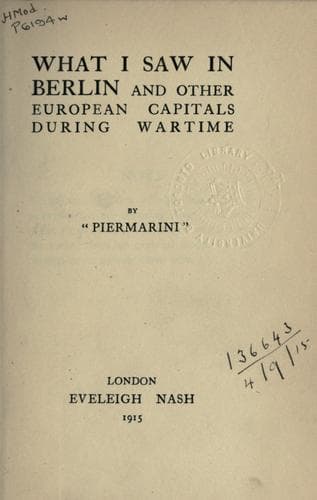
What I Saw in Berlin and Other European Capitals During WartimePiermarini
History
What I Saw in Berlin and Other European Capitals During Wartime
Piermarini
Europe -- Description and travel; World War, 1914-1918 -- Personal narratives
I knew that some quotations from my newspaper articles had appeared in
the German papers, and I was certain that the police, who, in Berlin,
are wonderfully well organised, had managed to identify the man who
had written them with the man who had awakened their vigilance a week
before the articles appeared.
It was true that this time I had entered Germany through Switzerland,
and that they would never think that a British newspaper correspondent
would take the trouble to go all that way round. I could not help
realising, however, how awkward my position would be if I were to meet
face to face in a Berlin street one of the men who had arrested me two
months before.
The little dreary devil who hides himself at the bottom of every human
being's mind impelled me to go straight down the Leipziger-place to
Wilhelmstrasse, and from there to the Linden, the very parts of Berlin
where danger for me was greatest.
I was impressed by one great change at once; two months ago the streets
were full of soldiers idling about amongst the slow-moving crowd. Now I
had to walk half-an-hour before I met a single military uniform, and
that was worn by a wounded soldier. Evidently the contingent of troops
which had been kept waiting in Berlin had been poured on to the Russian
frontier.
As a protest against French and English fashions, the German
dressmakers are trying to make German ladies adopt all-German fashions;
the shop windows are full of dummies dressed in impossible clothes of
stiff, cheap-looking materials. The ladies' hats are in the flat, round
shape of the Bavarian peasant woman.
Some of the shops show what they call evening gowns, and touch the
extreme of bad taste with curious creations of a half-religious,
half-pantomime-like character. But I have never seen anyone wearing
these horrors.
Horse vehicles were much scarcer. When the war broke out Germany
thought she could get any amount of horses out of Norway, Sweden,
Denmark, and Holland, but these nations could only send a few
thousand animals, and Germany was in a terrible plight, as she needed
immediately about twenty thousand. Then she tried to get horses from
Austria and Hungary, but owing to the food and the bad quality of the
water the greater part of these animals fell sick or died. Lastly,
Germany had to take for military purposes all the horses she could find
in Germany and Belgium--even those which had formerly been judged unfit
for military service.
Taxi-cabs have reappeared in fairly large numbers.
The shortage of petrol, arising from the Russian occupation of Galicia,
has been a very severe blow for Germany, especially when one considers
that the enormous special reservoirs constructed in all the German
ports for the storage of large quantities of the precious liquid were
expecting large supplies when the war broke out--supplies which were
never delivered.
Public-domain text, read in full here on John Shaqi.
Reviews
Reviews
No reviews yet
Be the first to share your thoughts on this work.
Join the Discussion
Join the discussion
Sign in to leave a comment or review.
Sign InorCreate an account