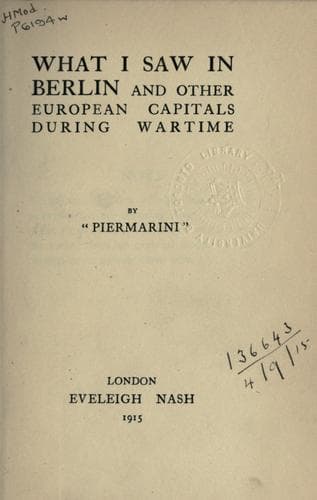
What I Saw in Berlin and Other European Capitals During WartimePiermarini
History
What I Saw in Berlin and Other European Capitals During Wartime
Piermarini
Europe -- Description and travel; World War, 1914-1918 -- Personal narratives
Unemployment seems to have increased enormously, especially for women,
owing to the fact that most manufacturers have closed down their works,
either for lack of raw material or for lack of demand. In some other
industries where women cannot take the place of men workers are badly
needed. I have been told that unemployment is even greater in the
northern towns. The toy-making and fancy goods industries are almost
entirely stopped, as the stores are full of goods prepared for the
usual exportation, which is, this year, entirely paralysed.
Paper, wool, metal, and wooden industries no longer receive their usual
supplies of raw material; and though articles manufactured of these are
badly needed, the works have had to close.
Metals have increased enormously in price, and all the reserves of
so-called noble metals, and also of nickel, etc., were requisitioned by
the military authorities. Such metals are indispensable in the making
of new guns, and also for repairing the old ones put out of action by
long usage. Lead is also very much dearer than usual, and everybody
is instructed to take down old gas and water pipes and to bring them
to special depôts, at which the metal is bought by weight at standard
prices, to be forwarded to military works, where it is converted into
bullets.
As for copper, a few old mines which had been given up forty years
since because they did not pay when the metal could be imported freely,
have been reopened with success and give employment to some of the
out-of-work folk.
Bread, except in the Zucker-Baeckereien, which are not forced to sell
at standard prices, is getting very scarce, and all bakers study every
possible way to make it as heavy and as economic as possible.
Wheat and other cereals, all equally scarce, have been seized by the
Government, which lets the different bakers have so much a week and
gives instructions about bread substitutes and the methods of making
them as healthful and nourishing as possible. The Government also
recommends the baker to make his wares as little appetising as possible
so that people should not eat too much out of _Feinsmecherei_--gluttony.
The last quality, if not the other two, is certainly prominent in the
German bread I have seen.
Though bread is not the most important part of the daily food of the
German population, and though in many provinces potatoes have almost
completely taken its place, yet the problem is very serious, and
Germany tries to face it in all possible ways. Large quantities of
wheat have been imported from Roumania, and potatoes, dried peas, etc.,
from Switzerland.
Through Holland, Germany still gets a certain amount of fruit, beef,
and cheese. Special stores have been arranged for the preservation in
good condition of perishable goods for a fairly long time.
Public-domain text, read in full here on John Shaqi.
Reviews
Reviews
No reviews yet
Be the first to share your thoughts on this work.
Elsewhere in the archive
Join the Discussion
Join the discussion
Sign in to leave a comment or review.
Sign InorCreate an account