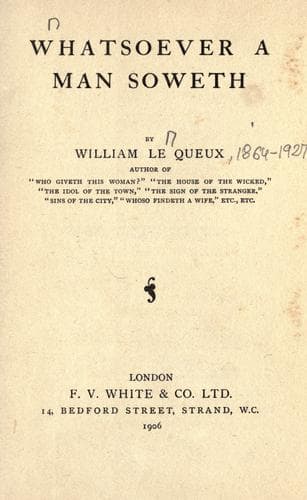
London (England) -- Fiction; Man-woman relationships -- Fiction; Mystery fiction
"Empty!" she echoed, raising herself to her feet with an effort, but
reeling unsteadily back to the couch, for her head was still swimming
after the effects of the chloroform. "The fiends!" she cried.
"And poor Jane. How is she?"
"I much regret, madam, that the chloroform administered to her has had a
fatal effect," said the doctor, gravely.
"Dead! Jane dead?"
"Yes. They've killed her," declared the inspector. "It's wilful
murder, that's what it is, mum. Therefore, if you can give us any
information as to who these ruffians may be we'll be very glad. We must
arrest them at all costs. Who do you think they might be?"
But Mrs Parham, although a strange look crossed her white, haggard
features, made no response to the officer's question.
"Poor Jane! Poor Jane--the brutes!" she kept on repeating, her wild
eyes staring across to where the body of the dead maid-servant was
lying.
From her manner I felt convinced that she suspected who the intruders
were, now that she knew that their motive had been to search in that
secret cavity beneath the floor of the drawing-room, and possess
themselves of something concealed there.
Would she denounce them?
The inspector again questioned her, but her answers were evasive.
"My husband is in the country," she explained. "He is very often away,
for his business often takes him on the Continent, to Paris and
Amsterdam."
"But how do you think these men got into the house?" the officer asked.
"I notice that the inner glass door of the hall closes with a latch
which can only be opened from the inside. Therefore, if they had
entered the front door with a false key they could not have passed the
inner door."
This fact was interesting, and one which I had entirely overlooked.
"I have no idea how they could have entered. Perhaps by a window."
"Or perhaps by the servants' entrance," Lane suggested.
"They couldn't have got in that way, mum, because they'd have to pass
through the kitchen, and cook was there all the time. Besides, we're
always very careful that that door is never left ajar."
"It's evident that they were concealed in the house," I remarked,
recollecting that tall shadowy figure that had crossed the room on
tip-toe at the instant that the blind had been lowered.
"Of course," agreed the inspector. "But what we want to know is whether
this lady has any suspicion of anyone to whose advantage it would be to
obtain possession of what was concealed there."
"I don't know what was in there," she declared, in a weak, nervous
voice. "My husband made the place himself a few months ago, as he often
has valuable jewellery here. In the City he has a strong room, of
course, but here he deemed it best to make a secret hiding-place rather
than have a fire-proof safe, which is always discussed by servants, and
the knowledge of which in a private house so soon becomes common
property."
"Then he used to keep valuables there?" asked the inspector.
Public-domain text, read in full here on John Shaqi.
Reviews
Reviews
No reviews yet
Be the first to share your thoughts on this work.
Elsewhere in the archive
Join the Discussion
Join the discussion
Sign in to leave a comment or review.
Sign InorCreate an account