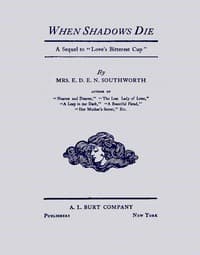
When shadows dieSouthworth, Emma Dorothy Eliza Nevitte
General
When shadows die
Southworth, Emma Dorothy Eliza Nevitte
American fiction -- 19th century
“The old manor house was shockingly out of repair, but because it was
the best building on the estate it was occupied by my father’s land
steward, O’Nally, and his wife.
“These two had been old servants of my mother’s family, and had been
very much devoted to her.
“After my father’s arrival with me at the house they also acted in the
capacity of butler and housekeeper.
“My father had brought with him a valet and a groom, and for me a nurse
and a governess.
“I was very warmly welcomed and fondly caressed by my mother’s old
servants, and so for the first few days I was very happy at Weirdwaste.
“We had no neighbors but the poor tenantry in the huts, on the waste
behind the manor house.
“And we saw no company but the vicar of the little Protestant parish, in
the village of Bantrim, ten miles inland, and the county practitioner
from the same place.
“These two old men remain strong, clear portraits in the gallery of my
memory.
“The vicar, Mr. Clement, was a large, fair, clean-shaved, bald-headed
old gentleman, with blue eyes and a beaming smile. He was very, very
good to me, and I soon learned to love him.
“The medical practitioner, Dr. Alexander, was a tall, gaunt, high-nosed,
red-faced man, with a shock of iron-gray hair and whiskers; a formidable
frown and a brusque manner. He also was very, very kind to me, but I
never got over my fear of him.
“My father did not intend to remain at Weirdwaste, as I soon found out.
He had the vicar and doctor come and spend the day and dine at the
house, so that they might see the child who was to be left at Weirdwaste
under their joint care.
“The doctor pronounced me a wonderfully sound and healthy child, who
would grow finely in the pure, invigorating air of the seaside. The
doctor promised to look after my health, and the vicar to superintend my
education. And both engaged to write frequently and keep my father
advised as to my welfare.
“So, having taken every precaution he thought necessary to my
well-being, and having settled the urgent business that brought him to
Ireland, my father bade me good-by, and left Weirdwaste to travel on the
Continent.
“And then began the loneliest life ever led by motherless child.
“O’Nally and his wife were an old couple. They kept two old servants—a
woman, who did the housework; and a man, who did the outdoor work. And
they kept an old horse and an old jaunting car.
“My nurse was a respectable, elderly matron; my governess, a discreet,
middle-aged maiden, selected by my father especially for good qualities.
Surely I had all the care and protection that was needed. But I had no
love, no play, no amusement, no companions. Even the warm-hearted
peasant women, who had come down from their huts on the waste to welcome
their little lady of the manor, came no more after that first day—not
that they had ceased to care for me, but because the occasion of their
coming had passed, and their hard work kept them all at home.
Public-domain text, read in full here on John Shaqi.
Reviews
Reviews
No reviews yet
Be the first to share your thoughts on this work.
Elsewhere in the archive
Join the Discussion
Join the discussion
Sign in to leave a comment or review.
Sign InorCreate an account