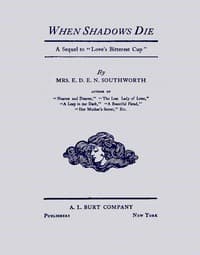
When shadows dieSouthworth, Emma Dorothy Eliza Nevitte
General
When shadows die
Southworth, Emma Dorothy Eliza Nevitte
American fiction -- 19th century
“I heard the steward remark to his wife that the new countess must be
well off, or the earl must have come into money some way, for this was
the very first Christmas that he had ever sent anything to the poor on
the estate. As the guardian of his daughter, the heiress, he forgave
many of them their rent, but he never helped them in any other way. And
so at Christmas the old people on the waste were made happy. And now let
me add here that as long as I remained at the old manor house this
Christmas dole came every year.
“After this I heard less of the cruelty of my father in afflicting me
with a stepmother. I heard even less of the wickedness of stepmothers in
general and the probable enormity of my stepmother in particular.
“The old people from the waste came down in crowds to the manor house on
Christmas Day to thank me for the dole that had been sent to them on
Christmas Eve. This was the only pleasure we had. There was no
merrymaking, and the state of the roads prevented us even from going to
church.
“Oh, the dreary winter that followed! No one came to the house except
the vicar and the doctor, who made weekly calls to report to my father.
And we went nowhere at all. That was my first winter at Weirdwaste. And
here let me add that all succeeding winters were like that.
“I had no companions, no amusements, no occupations except my
schoolbooks and my piano. I had not even a pet bird, or cat, or dog.
“The steward and his wife were good to me, but they were engaged in
their affairs. Miss Murray was faithful, but when she was not hearing my
lessons, or guiding my fingers over the keys of the piano, she was
busied in reading. I never knew anybody to read so much as she did. She
had no other recreation.
“When the spring returned we began to take walks on the sand again when
the tide was out; and we drove to church on Sundays when the state of
the roads permitted us.
“On the first of August we received news from my father. He was at
Enderby Castle, to which he had taken my stepmother for a temporary
sojourn. He wrote to the steward to tell him that an heir had been born
to Enderby; and he wrote to me to say that my new mother had given me a
dear little brother, and that he hoped I would love them both very much.
“I was not quite four years old when my own dear mother died. I was but
a few weeks past five now when I was told that I had a little brother by
my father’s new wife, and that I must love both.
“I could not do it. You will see what a sensitive and badly trained
child I was when I tell you that I fell into hysterical sobs and tears,
and refused to be comforted. It seemed to me that I had quite lost my
father—that he had been taken away from me by the new woman and the new
child. I remember crying aloud to my own mother in heaven to come and
take me away, because no one cared for me on earth.
“Miss Murray coaxed, lectured, remonstrated, all in vain. I would not
hear reason or receive consolation.
Public-domain text, read in full here on John Shaqi.
Reviews
Reviews
No reviews yet
Be the first to share your thoughts on this work.
Elsewhere in the archive
Join the Discussion
Join the discussion
Sign in to leave a comment or review.
Sign InorCreate an account