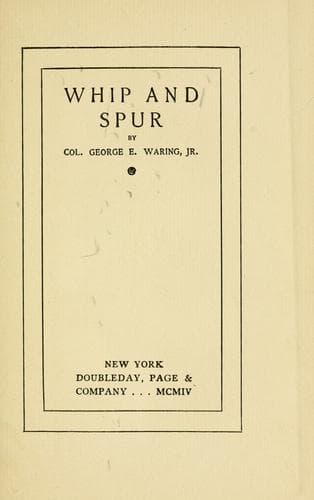
Fox hunting; Horses; United States -- History -- Civil War, 1861-1865 -- Personal narratives
He had been brought up by the tenderest of mothers at the castle of
Schlodien (I think in Silesia), had early joined the Cuirassiers of the
Body Guard, had fought a fatal duel in which he had been the aggressor,
and had been condemned to the Fortress of Spandau. Only his mother's
great influence (exercised without the knowledge of his stern and much
older father, who was then on his distant estates) had secured for him
an opportunity to escape. He had come directly to America, and had
remained near Boston until he received intimation (again the result
of his mother's influence with Baron Gerolt, the Prussian Minister at
Washington) that his return under the Extradition Treaty was being
urged at the solicitation of the family of his fallen antagonist. He
had then taken refuge in a remote town in South Missouri, where he
amused himself with shooting. His mother had written to him but once,
and had not been able to send him money. He had at last returned to
St. Louis, where he had contracted some small debts which Voisin and
another kind friend had assumed. To reimburse them and to gain more
perfect seclusion, he had resolved to enlist in the Regular Army. It
was a sad conclusion of his career, but as an honorable man (and a
pursued one) he had no choice but to accept it.
It was the old story,--_noblesse oblige_. There was but one way out
of a sad affair, and--like a very Graf zu--this stripling, who had been
born and bred to a better fate, faced the penalty of his misfortune
without flinching. I tried infinite suggestions, but nothing else
offered the immediate money which alone could relieve him of debt and
restore him his wardrobe and the portraits of his mother and sister,
which with a few well-worn letters, were all he had to cheer him in his
exile. We sat till far into the night and until my kindest sympathies
were fully aroused by the utter and almost childlike simplicity and
frankness with which the poor boy told of his sorrows. I had been
taught by a very ample experience to look with much caution on German
counts and barons,--an experience that, if it was worth what it had
cost, I could not prize too highly; but here was an entirely new type,
a combination of the gentlest breeding with an unsophistication that
argued more of a mother's care than of garrison influences, and an
utter absence of the devil-may-care manner that army life in Germany
had hitherto seemed to give. With the improvidence of one who had
never known the lack of money, he had lodged himself at the Everett
House; and as I left him at its door, I resolved to lose no time in
getting him enlisted and stopping an expense that would only add to
his troubles. The next day I saw the official who had charge of the
making up of the city's quota, and easily arranged for the examination
of my candidate. Dohna begged me to secure his admission to a command
whose officers would be able to appreciate his difficult position, and
a weary time I had of it.
Public-domain text, read in full here on John Shaqi.
Reviews
Reviews
No reviews yet
Be the first to share your thoughts on this work.
Join the Discussion
Join the discussion
Sign in to leave a comment or review.
Sign InorCreate an account