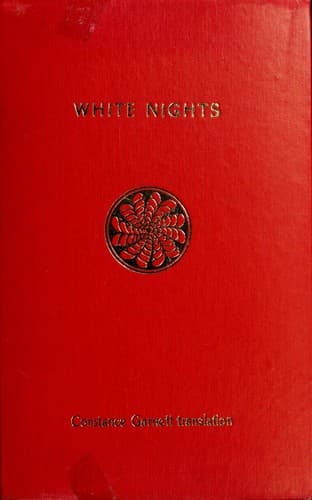
White nights, and other storiesDostoyevsky, Fyodor
General
White nights, and other stories
Dostoyevsky, Fyodor
Dostoyevsky, Fyodor, 1821-1881 -- Translations into English; Russian fiction -- Translations into English
But can you really be so credulous as to think that I will print all
this and give it to you to read too? And another problem: why do I call
you "gentlemen," why do I address you as though you really were my
readers? Such confessions as I intend to make are never printed nor
given to other people to read. Anyway, I am not strong-minded enough for
that, and I don't see why I should be. But you see a fancy has occurred
to me and I want to realize it at all costs. Let me explain.
Every man has reminiscences which he would not tell to every one, but
only to his friends. He has other matters in his mind which he would not
reveal even to his friends, but only to himself, and that in secret. But
there are other things which a man is afraid to tell even to himself,
and every decent man has a number of such things stored away in his
mind. The more decent he is, the greater the number of such things in
his mind. Anyway, I have only lately determined to remember some of my
early adventures. Till now I have always avoided them, even with a
certain uneasiness. Now, when I am not only recalling them, but have
actually decided to write an account of them, I want to try the
experiment whether one can, even with oneself, be perfectly open and not
take fright at the whole truth. I will observe, in parenthesis, that
Heine says that a true autobiography is almost an impossibility, and
that man is bound to lie about himself. He considers that Rousseau
certainly told lies about himself in his confessions, and even
intentionally lied, out of vanity. I am convinced that Heine is right; I
quite understand how sometimes one may, out of sheer vanity, attribute
regular crimes to oneself, and indeed I can very well conceive that kind
of vanity. But Heine judged of people who made their confessions to the
public. I write only for myself, and I wish to declare once and for all
that if I write as though I were addressing readers, that is simply
because it is easier for me to write in that form. It is a form, an
empty form--I shall never have readers. I have made this plain
already....
I don't wish to be hampered by any restrictions in the compilation of my
notes. I shall not attempt any system or method. I will jot things down
as I remember them.
But here, perhaps, some one will catch at the word and ask me: if you
really don't reckon on readers, why do you make such compacts with
yourself--and on paper too--that is, that you won't attempt any system
or method, that you jot things down as you remember them, and so on, and
so on? Why are you explaining? Why do you apologize?
Well, there it is, I answer.
Public-domain text, read in full here on John Shaqi.
Reviews
Reviews
No reviews yet
Be the first to share your thoughts on this work.
Join the Discussion
Join the discussion
Sign in to leave a comment or review.
Sign InorCreate an account