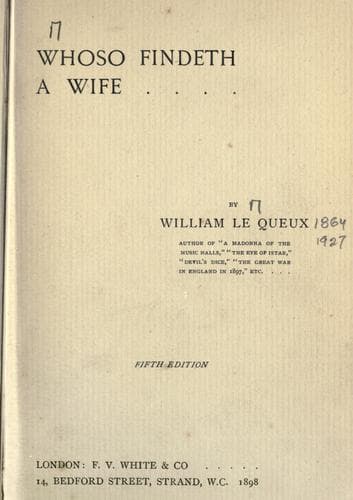
England -- Fiction; Political fiction; Politicians -- Fiction; Spy stories
"I fear so," I said despondently. "If war is really declared, a
conflict must very soon occur, and the struggle will then be long and
deadly."
"But surely the Government will not allow an enemy to land upon English
soil," she exclaimed, still holding the paper in her trembling hands.
"What are ambassadors for but to avert such catastrophes as this?"
"Ambassadors," exclaimed Beck, "appear to me to be useless pawns.
Surely our Embassy at St Petersburg must have been asleep not to have
given the Government warning of the plans of Russia long ago.
Preparations for war against a power like England are not made without
very careful deliberation."
"But can we be invaded?" I queried.
"No doubt," Beck replied promptly. "The opinions of our greatest
strategists are unanimous that, under certain conditions, France and
Russia combined could invade our island. It is all very well for people
to talk about England's maritime power; but is it what we believe it to
be? I think not."
Having made a deep study of this very question, I was, although a loyal
and patriotic Englishman, compelled to agree with him in a certain
measure. Once, not so very long ago, it was generally believed, even by
our greatest military and naval experts, that should England become
engaged with a first-rate foreign Power, she could, single-handed, in a
week close every one of her enemy's ports and have a fleet ready to
reduce at its leisure everything he held beyond the seas. Indeed, some
authorities went so far as to declare that with almost any two Powers
against her, she could do as much; and it was that recognition of this
power abroad that gave England, in spite of her military weakness, so
commanding a position in Europe. But since the Franco-Russian Alliance
the increase in the fleets of the Powers had been so rapid that we had
utterly failed to keep pace with them. We built huge, unwieldy
battleships, while our enemies constructed the fastest cruisers and
torpedo-boat destroyers afloat, thereby sweeping away our hitherto
undisputed mastery of the sea.
"The great danger that appears to me," Beck said presently, after we had
been discussing the serious outlook at considerable length, "is that we
may be blockaded by these two hostile powers, so as to reduce us near
starvation, and compel us to surrender."
"But not before we have engaged the enemy at sea and given them a taste
of the lion's paw," I observed.
"Of course. First, we must expect a great naval battle or battles,
followed by a dash upon our territory and the landing of the hostile
armies. If England received one serious reverse at sea, she could never
recover from it. The loss of her maritime power would paralyse her."
"I know," I said. "That argument is trite enough. But I, nevertheless,
believe that England is still, and will be for many centuries to come,
Queen of the Sea."
Public-domain text, read in full here on John Shaqi.
Reviews
Reviews
No reviews yet
Be the first to share your thoughts on this work.
Join the Discussion
Join the discussion
Sign in to leave a comment or review.
Sign InorCreate an account