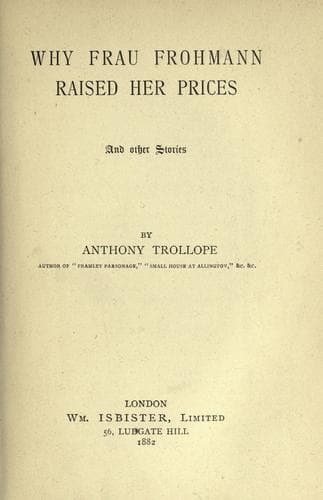
Why Frau Frohmann Raised Her Prices, and Other StoriesTrollope, Anthony
General
Why Frau Frohmann Raised Her Prices, and Other Stories
Trollope, Anthony
English fiction -- 19th century; Manners and customs -- Fiction; Short stories, English
She did not at all like swimming with the stream. There was something
conveyed by the idea which was repugnant to her sense of honour. Did it
not mean that she was to increase her prices because other people
increased theirs, whether it was wrong or right? She hated the doing of
anything because other people did it. Was not that base propensity to
imitation the cause of the long petticoats which all the girls were
wearing? Was it not thus that all those vile changes were effected which
she saw around her on every side? Had it not been her glory, her great
resolve, to stand as fast as possible on the old ways? And now in her
great attempt to do so, was she to be foiled thus easily?
It was clear to her that she must be foiled, if not in one way, then in
another. She must either raise her prices, or else retire to Schwatz.
She had been thoroughly beaten in her endeavour to make others carry on
their trade in accordance with her theories. On every side she had been
beaten. There was not a poor woman in the valley, not one of those who
had wont to be so submissive and gracious to her, who had not deserted
her. A proposed reduction of two kreutzers on a dozen of eggs had
changed the most constant of humble friends into the bitterest foes.
Seppel would have gone through fire and water for her. Anything that a
man’s strength or courage could do, he would have done. But a threat of
going back to the old wages had conquered even Seppel’s gratitude.
Concurrent testimony had convinced her that she must either yield--or
go. But, when she came to think of it in her solitude, she did not wish
to go. Schwatz! oh yes; it would be very well to have a quiet place
ready chosen for retirement when retirement should be necessary. But
what did retirement mean? Would it not be to her simply a beginning of
dying? A man, or a woman, should retire when no longer able to do the
work of the world. But who in all the world could keep the Brunnenthal
Peacock as well as she? Was she fatigued with her kitchen, or worn out
with the charge of her guests, or worried inwardly by the anxieties of
her position? Not in the least, not at all, but for this later
misfortune which had come upon her, a misfortune which she knew how to
remedy at once if only she could bring herself to apply the remedy. The
kaplan had indiscreetly suggested to her that as Malchen was about to
marry and be taken away into the town, it would be a good thing that
Peter should take a wife, so that there might be a future mistress of
the establishment in readiness. The idea caused her to arm herself
instantly with renewed self-assertion. So;--they were already preparing
for her departure to Schwatz! It was thus she communed with herself.
They had already made up their minds that she must succumb to these
difficulties and go! The idea had come simply from the kaplan without
consultation with any one, but to the Frau it seemed as though the whole
valley were already preparing for her departure.
Public-domain text, read in full here on John Shaqi.
Reviews
Reviews
No reviews yet
Be the first to share your thoughts on this work.
Join the Discussion
Join the discussion
Sign in to leave a comment or review.
Sign InorCreate an account