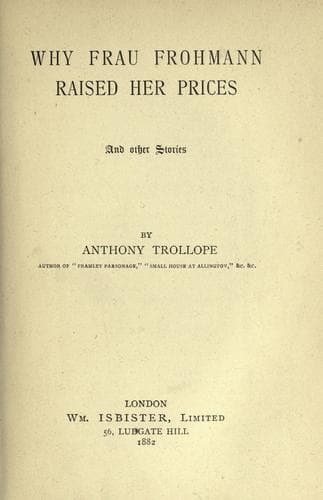
Why Frau Frohmann Raised Her Prices, and Other StoriesTrollope, Anthony
General
Why Frau Frohmann Raised Her Prices, and Other Stories
Trollope, Anthony
English fiction -- 19th century; Manners and customs -- Fiction; Short stories, English
“To people with fixed incomes. They must suffer, Frau Frohmann. There is
an old saying that in making laws you cannot look after all the little
things. The people who work and earn their living are the multitude, and
to them these matters adjust themselves. The few who live upon what they
have saved or others have saved for them must go to the wall.” Neither
did the Frau understand this; but she at once made up her mind that,
however necessary it might be to raise her prices against the Weisses
and the rest of the world, she would never raise them against those two
poor desolate frauleins.
So Herr Weiss had had his salary raised, and had said nothing to her
about it, no doubt prudently wishing to conceal the matter! He had said
nothing to her about it, although he had talked to her about her own
affairs, and had applauded her courage and her old conservatism in that
she would not demand that extra zwansiger and a half! This hardened her
heart so much that she felt she would have a pleasure in sending a
circular to him as to the new tariff. He might come or let it alone, as
he pleased,--certainly he ought to have told her that his own salary had
been increased!
But there was more to do than sending out the new circular to her
customers. How was she to send a circular round the valley to the old
women and the others concerned? How was she to make Seppel, and Anton,
and Josephine Bull understand that they should be forgiven, and have
their old prices and their increased wages if they would come back to
their allegiance, and never say a word again as to the sad affairs of
the past summer? This circular must be of a nature very different from
that which would serve for her customers. Thinking over it, she came to
the opinion that Suse Krapp would be the best circular. A day or two
after the Cartwrights were gone, she sent for Suse.
Suse was by no means a bad diplomate. When gaining her point she had no
desire to triumph outwardly. When feeling herself a conqueror, she was
quite ready to flatter the conquered one. She had never been more
gracious, more submissive, or more ready to declare that in all matters
the Frau’s will was the law of the valley than now, when she was given
to understand that everything should be bought on the same terms as
heretofore, that the dairy should be discontinued during the next
season, and that the wild fruits of the woods and mountains should be
made welcome at the Peacock as had heretofore always been the case.
“To-morrow will be the happiest day that ever was in the valley,” said
Suse in her enthusiasm. “And as for Seppel, he was telling me only
yesterday that he would never be a happy man again till he could find
himself once more at work in the old shed behind the chapel.”
Then Suse was told that Seppel might come as soon as he pleased.
Public-domain text, read in full here on John Shaqi.
Reviews
Reviews
No reviews yet
Be the first to share your thoughts on this work.
Join the Discussion
Join the discussion
Sign in to leave a comment or review.
Sign InorCreate an account