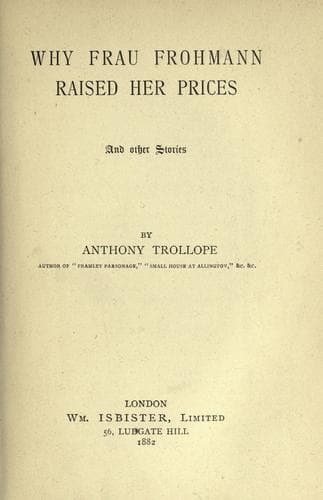
Why Frau Frohmann Raised Her Prices, and Other StoriesTrollope, Anthony
General
Why Frau Frohmann Raised Her Prices, and Other Stories
Trollope, Anthony
English fiction -- 19th century; Manners and customs -- Fiction; Short stories, English
“She didn’t do you any harm, I dare say.”
“Harm;--oh dear no! She couldn’t do me any harm if she tried. But I
thought I’d tell you, sir, because you said it would be so. The people
don’t seem to think any more of seven zwansigers and a half than they do
of six! It’s very odd,--very odd, indeed. I suppose it’s all right,
sir?” This she asked, still thinking that there must be something wrong
in the world when so monstrous a condition of things seemed to prevail.
“They’d think a great deal of it if you charged them more than they
believed sufficient to give you a fair profit for your outlay and
trouble.”
“How can they know anything about it, Mr. Cartwright?”
“Ah,--indeed. How do they? But they do. You and I, Frau Frohmann, must
study these matters very closely before we can find out how they adjust
themselves. But we may be sure of this, that the world will never
complain of fair prices, will never long endure unfair prices, and will
give no thanks at all to those who sell their goods at a loss.”
The Frau curtseyed and retired,--quite satisfied that she had done the
right thing in raising her prices; but still feeling that she had many a
struggle to make before she could understand the matter.
THE LADY OF LAUNAY.
CHAPTER I.
HOW BESSY PRYOR BECAME A YOUNG LADY OF IMPORTANCE.
How great is the difference between doing our duty and desiring to do
it; between doing our duty and a conscientious struggle to do it;
between duty really done and that satisfactory state of mind which comes
from a conviction that it has been performed. Mrs. Miles was a lady who
through her whole life had thought of little else than duty. Though she
was possessed of wealth and social position, though she had been a
beautiful woman, though all phases of self-indulgent life had been open
to her, she had always adhered to her own idea of duty. Many delights
had tempted her. She would fain have travelled, so as to see the
loveliness of the world; but she had always remained at home. She could
have enjoyed the society of intelligent sojourners in capitals; but she
had confined herself to that of her country neighbours. In early youth
she had felt herself to be influenced by a taste for dress; she had
consequently compelled herself to use raiment of extreme simplicity.
She would buy no pictures, no gems, no china, because when young she
found that she liked such things too well. She would not leave the
parish church to hear a good sermon elsewhere, because even a sermon
might be a snare. In the early days of her widowed life it became, she
thought, her duty to adopt one of two little motherless, fatherless
girls, who had been left altogether unprovided for in the world; and
having the choice between the two, she took the plain one, who had weak
eyes and a downcast, unhappy look, because it was her duty to deny
herself. It was not her fault that the child, who was so unattractive at
six, had become beautiful at sixteen, with sweet soft eyes, still
Public-domain text, read in full here on John Shaqi.
Reviews
Reviews
No reviews yet
Be the first to share your thoughts on this work.
Elsewhere in the archive
Join the Discussion
Join the discussion
Sign in to leave a comment or review.
Sign InorCreate an account