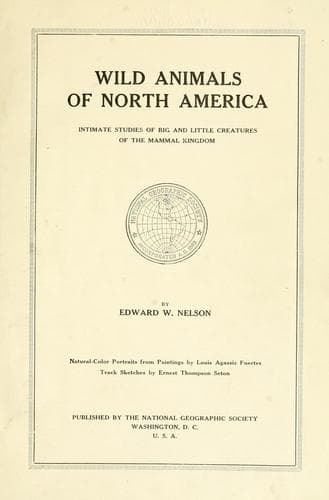
Wild Animals of North America: Intimate Studies of Big and Little Creatures of the Mammal KingdomNelson, Edward William
Science
Wild Animals of North America: Intimate Studies of Big and Little Creatures of the Mammal Kingdom
Nelson, Edward William
Mammals -- North America
The Arctic fox, clothed in long, fluffy white fur, is an extremely
handsome animal, about two-thirds the size of the common red fox. It
is a circumpolar species, which in America ranges over all the barren
grounds beyond the limit of trees, including the coastal belt of tundra
from the Peninsula of Alaska to Bering Straits, the Arctic islands, and
the frozen sea to beyond 83 degrees of latitude.
The blue fox of commerce is a color phase of this species, usually of
sporadic occurrence, like the black phase of the red fox. The white fox
makes its burrow either in a dry mound, under a large rock, or in the
snow, where its young are brought forth and cared for with the devotion
which appears to characterize all foxes.
How this small and delicately formed animal manages to sustain life
under the rigorous winter conditions of the far north has always been a
mystery to me. I have seen its tracks on the sea ice miles from shore.
It regularly wanders far and wide over these desolate icy wastes, which
can offer only the most remote chance for food. However, it appears to
thrive, with other animal life, even where months of continuous night
follow the long summer day.
The food of the Arctic fox includes nearly all species of the wild-fowl
which each summer swarm into the far North to breed. There on the
tundras congregate myriads of ducks, geese, and waders, while on the
cliffs and rocky islands are countless gulls and other water birds. In
winter they find lemmings and other northern mice, occasional Arctic
hares, and ptarmigan, as well as fragments of prey left by Arctic
wolves or polar bears. Now and then the carcass of a whale is stranded
or frozen in the ice, furnishing an abundance of food, sometimes for a
year or more, to the foxes which gather about it from a great distance.
Perhaps owing to its limited experience with man, the northern animal
is much less suspicious than the southern red fox. During winter sledge
trips in Alaska I frequently had two or three of them gather about my
open camp on the coast, apparently fascinated by the little camp-fire
of driftwood. They would sit about, near by in the snow, for an hour or
two in the evening, every now and then uttering weak, husky barks like
small dogs.
The summer of 1881, when we landed from the _Corwin_ on Herald Island,
northwest of Bering Straits, we found many white foxes living in
burrows under large scattered rocks on the plateau summit. They had
never seen men before and our presence excited their most intense
interest and curiosity. One and sometimes two of them followed closely
at my heels wherever I went, and when I stopped to make notes or look
about, sat down and watched me with absurd gravity. Now and then one at
a distance would mount a rock to get a better view of the stranger.
Public-domain text, read in full here on John Shaqi.
Reviews
Reviews
No reviews yet
Be the first to share your thoughts on this work.
Join the Discussion
Join the discussion
Sign in to leave a comment or review.
Sign InorCreate an account