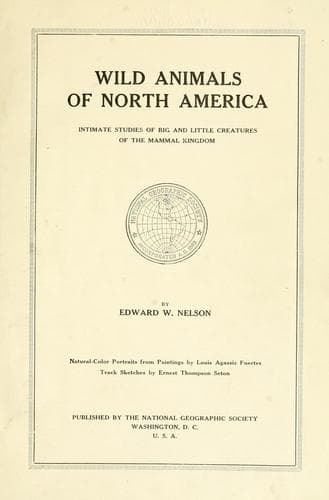
Wild Animals of North America: Intimate Studies of Big and Little Creatures of the Mammal KingdomNelson, Edward William
Science
Wild Animals of North America: Intimate Studies of Big and Little Creatures of the Mammal Kingdom
Nelson, Edward William
Mammals -- North America
The Alaskan brown bears form a group of gigantic animals peculiar to
North America and limited to the coast and islands of Alaska, from the
head of Norton Sound to the Sitka Islands. The group includes a number
of species, individuals of two of which, _Ursus gyas_, of the Alaska
Peninsula, and _Ursus middendorffi_, of Kodiak Island, sometimes attain
a weight of 1,500 pounds or more, and are not only the largest existing
bears, but are the largest living carnivores in the world. They can be
likened only to the great cave bears, which were the haunting terror
of primitive mankind during the “Old Stone Age” in Europe. Brown bears
still exist in Europe and Asia, but they form a distinct group of much
smaller animals than the American species.
The Alaskan brown bears vary much in color, from a dull golden
yellowish to a dusky brown, becoming almost black in some species.
In color some of the darker species are indistinguishable from the
great grizzlies, with which in places they share their range; but the
relatively shorter, thicker, and more strongly curved claws on the
front feet of the brown bears are distinctive.
As a rule they are inoffensive giants and take flight at the first sign
of man. The taint left by a man’s recent track or the faintest odor on
the passing breeze, indicating the proximity of their dreaded enemy, is
enough to start the largest of them in instant flight. Instances are
reported of their having attacked people wantonly, but such cases are
extremely rare. When wounded or suddenly surprised at close quarters,
the instinct of self-defense not infrequently incites them to attack
their enemy with furious energy. Many Indian and white hunters have
been killed or terribly mauled by them in such encounters. At close
quarters their great size, strength, and activity--astonishing for such
apparently clumsy beasts--render them terrific antagonists.
Some of the species occupy open, rolling, or hilly tundras, and others
live on the steepest and most rugged mountain slopes amid glaciers,
rock slides, and perpetual snow-banks. On the approach of winter all
retreat to dry locations, usually in the hills, where they dig dens in
the earth or seek other cover to which they retire to hibernate, and
here the young, usually two or three in number, are born. They usually
emerge from hibernation in April or early May and wander about over the
snow-covered hills and mountains. At this time their dark forms and
their great tracks in the snow are so conspicuous that hunters have
little difficulty in finding them.
Public-domain text, read in full here on John Shaqi.
Reviews
Reviews
No reviews yet
Be the first to share your thoughts on this work.
Elsewhere in the archive
Join the Discussion
Join the discussion
Sign in to leave a comment or review.
Sign InorCreate an account