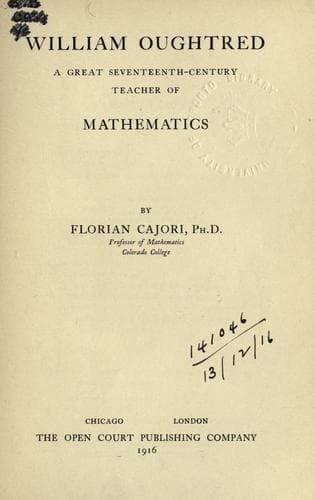
William Oughtred: A Great Seventeenth-Century Teacher of MathematicsCajori, Florian
History
William Oughtred: A Great Seventeenth-Century Teacher of Mathematics
Cajori, Florian
Mathematicians -- Biography; Mathematics -- Study and teaching -- History -- 17th century; Oughtred, William, 1575-1660
While he remained in that coll. [University College, Oxford] which was
five years . . . . he made an excursion for about 9 months to the
famous mathematician Will. Oughtred parson of Aldbury in Surrey, by
whom he was initiated in the study of mathematics, and afterwards
retiring to his coll. for a time, he at length went to London, was
entered a student in the Middle Temple.[58]
Extracts from letters of W. Gascoigne to Oughtred, of the years 1640 and
1641, throw some light upon mathematical teaching of the time:
Amongst the mathematical rarities these times have afforded, there are
none of that small number I (a late intruder into these studies) have
yet viewed, which so fully demonstrates their authors’ great abilities
as your Clavis, not richer in augmentations, than valuable for
contraction; . . . .
Your belief that there is in all inventions aliquid divinum, an
infusion beyond human cogitations, I am confident will appear notably
strengthened, if you please to afford this truth belief, that I entered
upon these studies accidentally after I betook myself to the country,
having never had so much aid as to be taught addition, nor the
discourse of an artist (having left both Oxford and London before I
knew what any proposition in geometry meant) to inform me what were the
best authors.[59]
The following extracts from two letters by W. Robinson, written before
the appearance of the 1647 English edition of the Clavis, express the
feeling of many readers of the Clavis on its extreme conciseness and
brevity of explanation:
I shall long exceedingly till I see your Clavis turned into a
pick-lock; and I beseech you enlarge it, and explain it what you can,
for we shall not need to fear either tautology or superfluity; you are
naturally concise, and your clear judgment makes you both methodical
and pithy; and your analytical way is indeed the only way. . . . .
I will once again earnestly entreat you, that you be rather diffuse in
the setting forth of your English mathematical Clavis, than concise,
considering that the wisest of men noted of old, and said stultorum
infinitus est numerus, these arts cannot be made too easy, they are so
abstruse of themselves, and men either so lazy or dull, that their
fastidious wits take a loathing at the very entrance of these studies,
unless it be sweetened on with plainness and facility. Brevity may well
argue a learned author, that without any excess or redundance, either
of matter or words, can give the very substance and essence of the
thing treated of; but it seldom makes a learned scholar; and if one be
capable, twenty are not; and if the master sum up in brief the pith of
his own long labours and travails, it is not easy to imagine that
scholars can with less labour than it cost their masters dive into the
depths thereof.[60]
Here is the judgment of another of Oughtred’s friends:
Public-domain text, read in full here on John Shaqi.
Reviews
Reviews
No reviews yet
Be the first to share your thoughts on this work.
Join the Discussion
Join the discussion
Sign in to leave a comment or review.
Sign InorCreate an account