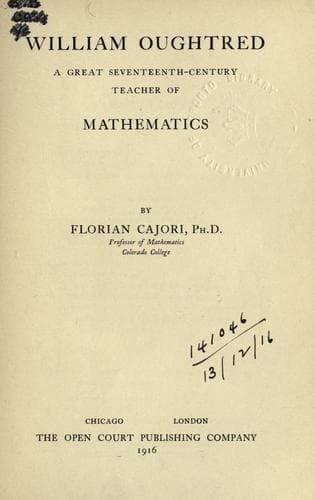
William Oughtred: A Great Seventeenth-Century Teacher of MathematicsCajori, Florian
History
William Oughtred: A Great Seventeenth-Century Teacher of Mathematics
Cajori, Florian
Mathematicians -- Biography; Mathematics -- Study and teaching -- History -- 17th century; Oughtred, William, 1575-1660
. . . . with the character I received from your and my noble friend Sir
Charles Cavendish, then at Paris, of your second edition of the same
piece, made me at my return into England speedily to get, and
diligently peruse the same. Neither truly did I find my expectation
deceived; having with admiration often considered how it was possible
(even in the hardest things of geometry) to deliver so much matter in
so few words, yet with such demonstrative clearness and perspicuity:
and hath often put me in mind of learned Mersennus his judgment (since
dead) of it, that there was more matter comprehended in that little
book than in Diophantus, and all the ancients. . . . .[61]
Oughtred’s own feeling was against diffuseness in textbook writing. In
his revisions of his Clavis the original character of that book was not
altered. In his reply to W. Robinson, Oughtred said:
. . . . But my art for all such mathematical inventions I have set down
in my Clavis Mathematica, which therefore in my title I say is tum
logisticae cum analyticae adeoque totius mathematicae quasi clavis,
which if any one of a mathematical genius will carefully study, (and
indeed it must be carefully studied,) he will not admire others, but
himself do wonders. But I (such is my tenuity) have enough fungi vice
cotis, acutum reddere quae ferrum valet, exsors ipsa secandi, or like
the touchstone, which being but a stone, base and little worth, can
shew the excellence and riches of gold.[62]
John Wallis held Oughtred’s Clavis in high regard. When in correspondence
with John Collins concerning plans for a new edition, Wallis wrote in
1666-67, six years after the death of Oughtred:
. . . . But for the goodness of the book in itself, it is that (I
confess) which I look upon as a very good book, and which doth in as
little room deliver as much of the fundamental and useful part of
geometry (as well as of arithmetic and algebra) as any book I know; and
why it should not be now acceptable I do not see. It is true, that as
in other things so in mathematics, fashions will daily alter, and that
which Mr. Oughtred designed by great letters may be now by others be
designed by small; but a mathematician will, with the same ease and
advantage, understand A_c, and a³ or aaa. . . . . And the like I judge
of Mr. Oughtred’s Clavis, which I look upon (as those pieces of Vieta
who first went in that way) as lasting books and classic authors in
this kind; to which, notwithstanding, every day may make new additions.
. . . .
But I confess, as to my own judgment, I am not for making the book
bigger, because it is contrary to the design of it, being intended for
a manual or contract; whereas comments, by enlarging it, do rather
destroy it. . . . . But it was by him intended, in a small epitome, to
give the substance of what is by others delivered in larger volumes. .
. . .[63]
Public-domain text, read in full here on John Shaqi.
Reviews
Reviews
No reviews yet
Be the first to share your thoughts on this work.
Join the Discussion
Join the discussion
Sign in to leave a comment or review.
Sign InorCreate an account