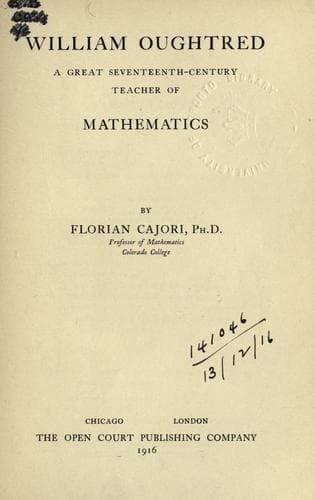
William Oughtred: A Great Seventeenth-Century Teacher of MathematicsCajori, Florian
History
William Oughtred: A Great Seventeenth-Century Teacher of Mathematics
Cajori, Florian
Mathematicians -- Biography; Mathematics -- Study and teaching -- History -- 17th century; Oughtred, William, 1575-1660
Some time ago I read in the elegant and truly precious book that you
have written on Algebra, about Descartes, this philosopher so extolled
above all for having arrived at a very perfect system by his own
powers, without the aid of others, this Descartes, I say, who has
received in geometry very great light from our Oughtred and our
Harriot, and has followed their track though he carefully suppressed
their names. I stated this in a conversation with a professor in
Utrecht (where I reside at present). He requested me to indicate to him
the page-numbers in the two authors which justified this accusation. I
admitted that I could not do so. The Géométrie of Descartes is not
sufficiently familiar to me, although with Oughtred I am fairly
familiar. I pray you therefore that you will assume this burden. Give
me at least those references to passages of the two authors from the
comparison of which the plagiarism by Descartes is the most
striking.[73]
Following Morland’s letter in the De algebra tractatus, is printed
Wallis’ reply, dated March 12, 1688 (“Stilo Angliae”), which is, in part,
as follows:
I nowhere give him the name of a plagiarist; I would not appear so
impolite. However this I say, the major part of his algebra (if not
all) is found before him in other authors (notably in our Harriot) whom
he does not designate by name. That algebra may be applied to geometry,
and that it is in fact so applied, is nothing new. Passing the ancients
in silence, we state that this has been done by Vieta, Ghetaldi,
Oughtred and others, before Descartes. They have resolved by algebra
and specious arithmetic [literal arithmetic] many geometrical problems.
. . . . But the question is not as to application of algebra to
geometry (a thing quite old), but of the Cartesian algebra considered
by itself.
Wallis then indicates in the 1659 edition of Descartes’ Géométrie where
the subjects treated on the first six pages are found in the writings of
earlier algebraists, particularly of Harriot and Oughtred. For example,
what is found on the first page of Descartes, relating to addition,
subtraction, multiplication, division, and root extraction, is declared
by Wallis to be drawn from Vieta, Ghetaldi, and Oughtred.
It is true that Descartes makes no mention of modern writers, except once
of Cardan. But it was not the purpose of Descartes to write a history of
algebra. To be sure, references to such of his immediate predecessors as
he had read would not have been out of place. Nevertheless, Wallis fails
to show that Descartes made illegitimate use of anything he may have seen
in Harriot or Oughtred.
Public-domain text, read in full here on John Shaqi.
Reviews
Reviews
No reviews yet
Be the first to share your thoughts on this work.
Join the Discussion
Join the discussion
Sign in to leave a comment or review.
Sign InorCreate an account