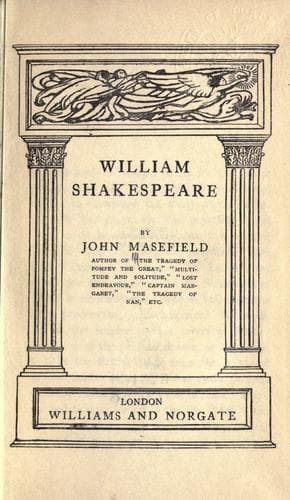
Shakespeare, William, 1564-1616 -- Criticism and interpretation
The action consists in the baffling of action. Mostly, it consists in
the baffling of life's effort to get back to her course. All through the
play there is the uneasiness of something trying to get done, something
from outside life trying to get into life, but baffled always because
the instrument chosen is, himself, a little outside life, as the wise
must be. This baffling of the purpose of the dead leads to a baffling
of the living, and, at last, to something like an arrest of life, a
deadlock, in which each act, however violent, makes the obscuring of
life's purpose greater.
The powers outside life send a poor ghost to Hamlet to prompt him to an
act of justice. After baffled hours, often interrupted by cock-crow, he
gives his message. Hamlet is charged with the double task of executing
judgment and showing mercy. It is a charge given to many people
(generally common people) in the system of the plays. It is given to two
other men in this play. It is nothing more than the fulfilling of the
kingly office, so bloodily seized by Claudius before the opening of the
play. At this point, it may be well to consider the society in which the
kingly office is to be exercised.
The society is created with Shakespeare's fullest power. It is not an
image of the world in little, like the world of the late historical
plays. It is an image of the world as intellect is made to feel it. It
is a society governed by the enemies of intellect, by the sensual and
the worldly, by deadly sinners and the philosophers of bread and cheese.
The King is a drunken, incestuous murderer, who fears intellect. The
Queen is a false woman, who cannot understand intellect. Polonius is a
counsellor who suspects intellect. Ophelia is a doll without intellect.
Laertes is a boor who destroys intellect. The courtiers are parasites
who flourish on the decay of intellect. Fortinbras, bright and noble,
marching to the drum to win a dunghill, gives a colour to the folly. The
only friends of the wise man are Horatio, the schoolfellow, and the
leader of a cry of players.
The task set by the dead is a simple one. All tasks are simple to the
simple-minded. To the delicate and complex mind so much of life is bound
up with every act that any violent act involves not only a large
personal sacrifice of ideal, but a tearing-up by the roots of half the
order of the world. Wisdom is founded upon justice; but justice, to the
wise man, is more a scrupulous quality in the mind than the doing of
expedient acts upon sinners. Hamlet is neither "weak" nor
"unpractical," as so many call him. What he hesitates to do may be
necessary, or even just, as the world goes, but it is a defilement of
personal ideals, difficult for a wise mind to justify. It is so great a
defilement, and a world so composed is so great a defilement, that death
seems preferable to action and existence alike.
Public-domain text, read in full here on John Shaqi.
Reviews
Reviews
No reviews yet
Be the first to share your thoughts on this work.
Join the Discussion
Join the discussion
Sign in to leave a comment or review.
Sign InorCreate an account