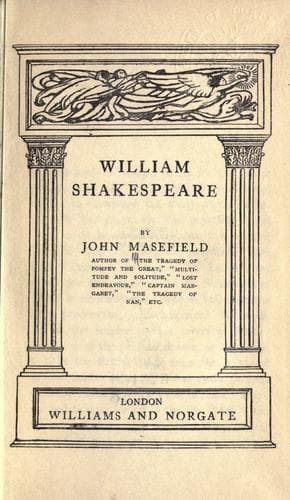
Shakespeare, William, 1564-1616 -- Criticism and interpretation
The play at this point presents a double image of action baffled by
wisdom. Hamlet baffles the dealing of the justice of Fate, and also the
death plotted for him by his uncle. His weapon, in both cases, is his
justice, his precise scrupulousness of mind, the niceness of mental
balance which gives to all that he says the double-edge of wisdom. It is
the faculty, translated into the finer terms of thought, which the ghost
seeks to make real with bloodshed. Justice, in her grosser as in her
finer form, is concerned with the finding of the truth. The first half
of the play, though it exposes and develops the fable, is a dual image
of a search for truth, of a seeking for a certainty that would justify
a violent act. The King is probing Hamlet's mind with gross human
probes, to find out if he is mad. Hamlet is searching the King's mind
with the finest of intellectual probes, to find out if he is guilty. The
probe used by him, the fragment of a play within a play, is the work of
a man with a knowledge of the impotence of intellect--
"Our wills and fates do so contrary run
That our devices still are overthrown"--
and a faith in the omnipotence of intellect--
"Our thoughts are ours, their ends none of our own."
To this man, five minutes after the lines have exposed the guilty man,
comes a chance to kill his uncle. Hamlet "might do it pat" while he is
at prayers. The knowledge that the sword will not reach the real man,
since damnation comes from within, not from without, arrests his hand.
Fate offers an instant for the doing of her purpose. Hamlet puts the
instant by, with his baffling slowness, made up of mercy and wisdom.
Fate, or the something outside life which demands the King's blood, so
that life may go back to her channel, is foiled. The action cannot bring
itself to be. A wise human purpose is, for the moment, stronger than the
eternal purpose of Nature, the roughly just.
It is a part of this play's ironic teaching that life must not be
baffled; but that, when she has been wrenched from her course, she must
either be wrenched back to it or kept violently in the channel to which
she has been forced.
Public-domain text, read in full here on John Shaqi.
Reviews
Reviews
No reviews yet
Be the first to share your thoughts on this work.
Join the Discussion
Join the discussion
Sign in to leave a comment or review.
Sign InorCreate an account