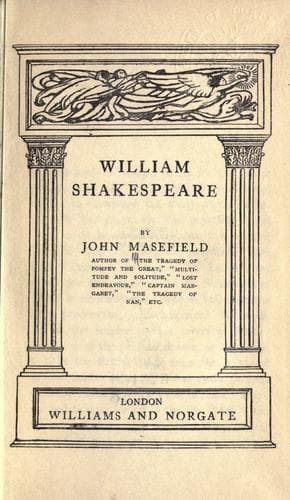
Shakespeare, William, 1564-1616 -- Criticism and interpretation
The play of _King Lear_ is based upon a fable and a fairy story. It
illustrates the most terrible forms of treachery, that of child against
father, and father against child. It is the most affecting and the
grandest of the plays.
The evil which makes the action springs from two sources, both fatal.
One is the blindness or fatuity in Lear, which makes him give away his
strength and cast out Cordelia. The other, equally deadly, but more
cruel in its results, springs from an unrepented treachery, done long
before by Gloucester, when he broke his marriage vows to beget Edmund.
Memory of the sweetness of that treachery gives to Gloucester a
blindness to the boy's nature, just as a sweetness, or ease, in the
treachery of giving up the cares of kingship (against oath and the
kingdom's good) helps to blind Lear to the natures of his daughters.
The blindness in the one case is sentimental, in the other wilful. Being
established, fate makes use of it. One of the chief lessons of the plays
is that man is only safe when his mind is perfectly just and calm. Any
injustice, trouble or hunger in the mind delivers man to powers who
restore calmness and justice by means violent or gentle according to the
strength of the disturbing obsession. This play begins at the moment
when an established blindness in two men is about to become an
instrument of fate for the violent opening of their eyes. The blindness
in both cases is against the course of nature. It is unnatural that Lear
should give his kingship to women, and that he should curse his youngest
child. It is unnatural that Gloucester should make much of a bastard son
whom he has hardly seen for nine years. It is deeply unnatural that both
Lear and Gloucester should believe evil suddenly of the youngest, best
beloved, and most faithful spirits in the play. As the blindness that
causes the injustice is great and unnatural, so the working of fate to
purge the eyes and restore the balance is violent and unnatural. Every
person important to the action is thrust into an unnatural way of life.
Goneril and Regan rule their father, commit the most ghastly and beastly
cruelty, lust after the same man, and die unnaturally (having betrayed
each other), the one by her sister's hand, the other by her own. Lear is
driven mad. The King of France is forced to war with his wife's sisters.
Edmund betrays his half-brother to ruin and his father to blindness.
Cornwall is stabbed by his servant. Edgar kills his half-brother.
Gloucester, thrust out blind, dies when he finds that his wronged son
loves him. Cordelia, fighting against her own blood, is betrayed to
death by one who claims to love her sisters. The honest mild man,
Albany, and the honest blunt man, Kent, survive the general ruin. Had
Kent been a little milder and Albany a little blunter in the first act,
before the fates were given strength, the ruin would not have been. All
the unnatural treacherous evil comes to pass, because for a few fatal
Public-domain text, read in full here on John Shaqi.
Reviews
Reviews
No reviews yet
Be the first to share your thoughts on this work.
Elsewhere in the archive
Join the Discussion
Join the discussion
Sign in to leave a comment or review.
Sign InorCreate an account