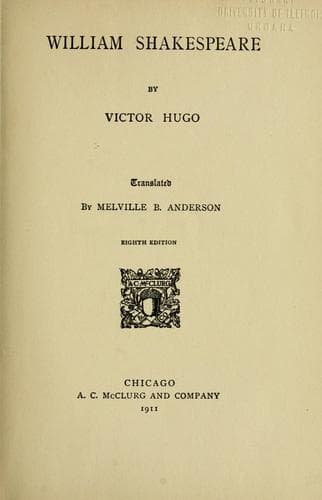
Dramatists, English -- Early modern, 1500-1700 -- Biography; Shakespeare, William, 1564-1616; Stratford-upon-Avon (England) -- Biography
Chrysippus of Tarsus, who lived about the hundred and thirtieth
Olympiad, forms an era in science. This philosopher, the same who
died, literally died, of laughing on seeing a donkey eat figs out
of a silver basin, had studied everything, gone into the depth of
everything, written seven hundred and five volumes, of which three
hundred and eleven were on dialectics, without having dedicated a
single one to a king,--a fact which astounds Diogenes Laërtius. He
condensed in his brain all human knowledge. His contemporaries named
him Light. Chrysippus signifying "golden horse," they said that he had
got detached from the chariot of the sun. He had taken for device "To
Me." He knew innumerable things,--among others these: The earth is
flat. The universe is round and limited. The best food for man is human
flesh. The community of women is the base of the social order. The
father ought to espouse his daughter. There is a word which kills the
serpent, a word which tames the bear, a word which arrests the flight
of eagles, and a word which drives the oxen from the beanfield. By
pronouncing from hour to hour the three names of the Egyptian Trinity,
Amon-Mouth-Khons, Andron of Argos contrived to cross the deserts of
Libya without drinking. Coffins ought not to be manufactured of cypress
wood, the sceptre of Jupiter being made of that wood. Themistoclea,
priestess of Delphi, had given birth to children, and yet had remained
a virgin. The just alone having authority to swear, it is by equity
that Jupiter has received the name of The Swearer. The phœnix of
Arabia lives in the fire. The earth is carried by the air as by a car.
The sun drinks from the ocean, and the moon from the rivers. For these
reasons the Athenians raised a statue to him on the Ceramicus, with
this inscription: "To Chrysippus, who knew everything."
About the same time, Sophocles wrote "Œdipus Rex."
And Aristotle believed in the story about Andron of Argos, and Plato in
the social principle of the community of women, and Gorgisippus in the
earth being flat; and Epicurus admitted as a fact that the earth was
supported by the air, and Hermodamantes that magic words mastered the
ox, the eagle, the bear, and the serpent; and Echecrates believed in
the immaculate maternity of Themistoclea, and Pythagoras in Jupiter's
sceptre made of cypress wood, and Posidonius in the ocean affording
drink to the sun and in the rivers quenching the thirst of the moon,
and Pyrrho in the phœnix existing in fire.
Excepting in this particular, Pyrrho was a sceptic. He made up for his
belief in that phœnix by doubting everything else.
Public-domain text, read in full here on John Shaqi.
Reviews
Reviews
No reviews yet
Be the first to share your thoughts on this work.
Join the Discussion
Join the discussion
Sign in to leave a comment or review.
Sign InorCreate an account