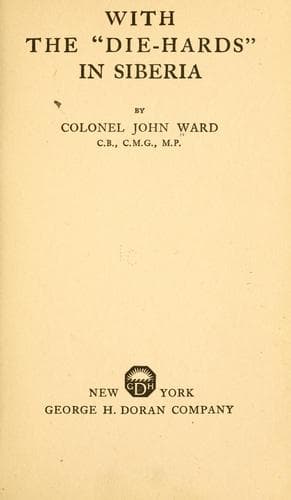
World War, 1914-1918 -- Personal narratives, English; World War, 1914-1918 -- Russia (Federation) -- Siberia
Six A.M. arrived, and my officers reported all men at work except eight,
and these reported later and asked forgiveness, which was readily
granted. I then informed the management that I intended to call a
meeting of the men and hear their grievances. The management tried to
dissuade me from my purpose, but I at once ordered their attendance in
the headquarters of the works at 10 A.M., when I would hear the men's
complaints. Promptly to time the work finished, and the men crowded to
the spot selected. A British sentry with fixed bayonet and loaded rifle
stood on either side as I sat at the table, while others were placed in
selected positions about the building. I called the managers and heads
of all the departments first, and warned them that I had been forced to
take this trouble into my own hands, that I intended to settle it, and
that if they interfered with the men in any way, either by harsh
measures or victimisation, I would place them under court-martial just
the same as I would any workman who prevented the smooth working of the
railway; in fact, they being presumably more intelligent, would find no
mercy. This information caused quite a commotion amongst all concerned.
I asked the men to state their grievances. The first workman said he had
no economic grievance; his was political. He had been told the Allies
were counter-revolutionists, and as such should be destroyed. Two or
three protested against this, and said they came out on economic
grounds. They said their objection was to piece-work. I tried to get a
statement from them that their wages were low, but they would not
consent to this, admitting that their pay for the same work was five
times what it was in 1917.
I came to the conclusion that it was more of a military movement on the
part of the Bolshevik leaders than a strike such as we understand it in
England. I gave my decision that the men's leaders were to be tried by
General Field Court-Martial. The men's committee then said that they had
never had the chance to meet anyone in authority before, that they were
anxious not to appear as enemies to the great English people, that if I
would carry out no further repressive action against them, they would
continue to work until the end of the war. They heard that Bolsheviks
were approaching their town, and knew the tortures in store for them if
they were found continuing to help the Allies in their advance to the
Urals. If I would secure protection for them they would sign an
agreement never to strike until the war in Russia had ended. I believed
them, and the agreement was signed, but I insisted upon disarmament.
That evening the time limit in which the arms were to be handed in
expired. We were informed by the local militia that some arms were
handed in voluntarily, but many more remained.
Public-domain text, read in full here on John Shaqi.
Reviews
Reviews
No reviews yet
Be the first to share your thoughts on this work.
Elsewhere in the archive
Join the Discussion
Join the discussion
Sign in to leave a comment or review.
Sign InorCreate an account