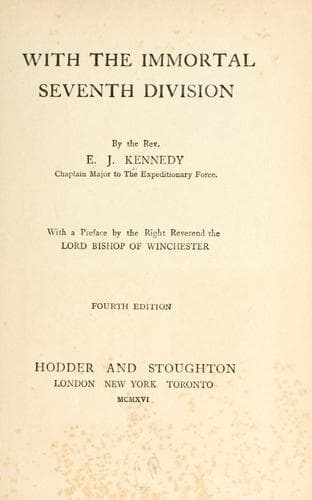
With The Immortal Seventh DivisionKennedy, Edmund John
History
With The Immortal Seventh Division
Kennedy, Edmund John
World War, 1914-1918 -- Personal narratives, British
The variety of circumstances under which men get wounded is unbounded.
Multitudes of those bowled over have never seen a German. It may be far
back in the rear that a 'Jack Johnson' or 'Black Maria' (for we have
many names for the German high explosive) has knocked a man out. It is
all over in a moment; in the quiet of the night, or amid the bustle of
the day the deadly shriek of an approaching shell falls upon the man's
ear, and before he can seek for cover--even supposing there is any to
hand--the roar of the explosion will probably be the last thing that he
will remember before he awakes to his agony. Or nearer to the line, the
whistle of an approaching shrapnel speaks of coming danger, and then a
prone figure on the ground tells of one more who has been 'pipped,' to
use a colloquialism of the Front. When we consider the extreme range of
a seventeen-inch gun as being not far short of thirty miles, the
difficulty of being out of range is at once apparent. Nearer at hand,
within a few yards, an accurately thrown bomb is a fruitful source of
injury to our fighting men, whilst in these days of accurate rifle fire
'snipers' mark the slightest movement at a thousand yards. In the fierce
rush of the taking of a trench, men are as thick on the ground as the
leaves of Vallombrosa. At such times, notwithstanding the specific
orders to the contrary, men are constantly helping each other. For
brotherly love will assert itself even amid the rush of battle. Here is
an order from the 'Standing Orders' of the Seventh Division:--
'Wounded men.--All ranks are forbidden to divert their attention from
the enemy in order to attend wounded officers or men.'
But notwithstanding this command, again and again heroic deeds are
performed by combatants in their endeavour to get their wounded comrades
out of imminent danger.
It was a noble deed of the Rev. Nevile Talbot, who, learning that his
brother in the Rifle Brigade was hit, rushed into the zone of fire, only
to find his beloved relative dead; straightway he immediately diverted
his attention to the need of a wounded 'Tommy' near by. The Rev. and
Honourable B.M. Peel was badly hit in the head and left leg, in charging
with the Welsh Fusiliers; true, he had no right to be there from a
military point of view, but I believe the O.C. had given him permission,
and certainly his heroic action inspired the men, and has left a
splendid memory in the minds of those who were with him. In such ways
the front line of casualties occur. How are they dealt with? I will
describe as briefly as possible the procedure which governs the
handling of the wounded from the fighting line to the Convalescent Home
in England.
(1) Nearly every Battalion has its Regimental Surgeon and
Bearers; the latter are men who are specially trained to
render First Aid, and to carry the wounded out of the zone
of immediate fire.
Public-domain text, read in full here on John Shaqi.
Reviews
Reviews
No reviews yet
Be the first to share your thoughts on this work.
Join the Discussion
Join the discussion
Sign in to leave a comment or review.
Sign InorCreate an account