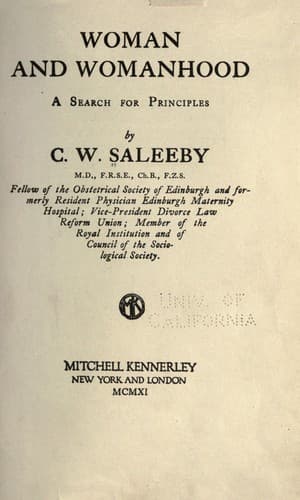
Woman and Womanhood: A Search for PrinciplesSaleeby, C. W. (Caleb Williams)
Science
Woman and Womanhood: A Search for Principles
Saleeby, C. W. (Caleb Williams)
Eugenics; Women
But whatever was the historical or evolutionary origin of sex, we may
here be excused for attaching more importance--for it is of great
practical consequence--to the origin or determination of sex in the
individual. At what stage and under what influences did the child that
is born a girl become female? To what extent can we control the
determination of sex? Why are the numbers of the sexes approximately so
equal? What determines the curious disproportions observed in many
families, which may be composed only of girls or only of boys; and, as
is asserted, also observed after wars and epidemics or during sieges,
when an abnormally high proportion of boys is said to be born? These are
some of the deeply interesting questions which men have always attempted
to answer--with the beginnings of substantial success during the present
century at last.
In general it is true that, the more we learn of the characters and
histories of living beings, the more importance we attach to nature or
birth and the less to nurture or environment, vastly important though
the latter be. Thus to the student of heredity nothing could well seem
more improbable, at any rate amongst the higher animals, than that
characters so profound as those of sex should be determined by nurture.
He simply cannot but believe that the sex of the individual is as inborn
as his backbone, and as incapable of being created by varying conditions
of nurture. The causation of sex is therefore really a problem in
heredity; and we may most confidently assert, in the first place, that
the sex of every human being is already determined at the moment of
conception when, indeed, the new individual is created: determined then
by the nature and constitution of the living cells--or of one of
them--which combine to form the new being. Subsequent attempts to affect
the sex, as by means of the mother's diet and the like, are palpably
hopeless from the outset and always will be. This is by no means to say
that conditions affecting the mother--as, for instance, the
semi-starvation of a prolonged siege--may not affect the construction of
the germ-cells which she houses, and which are constantly being formed
within her from the mother germ-cells, as they are called. But any given
final germ-cell, such as will combine with another from an individual of
the opposite sex to form a new being, is already determined, once for
all, to be of one sex or the other. We naturally ask, then, how the two
parents are concerned in this matter; and the first remarkable answer
returned by the Mendelian workers during the last three or four years is
that it is the mother who determines the sex of her children in the case
of all the higher animals. Her contribution to the new being is called
the ovum, and it is believed that ova are of two kinds, or, we are quite
right in saying, of two sexes.
Public-domain text, read in full here on John Shaqi.
Reviews
Reviews
No reviews yet
Be the first to share your thoughts on this work.
Join the Discussion
Join the discussion
Sign in to leave a comment or review.
Sign InorCreate an account