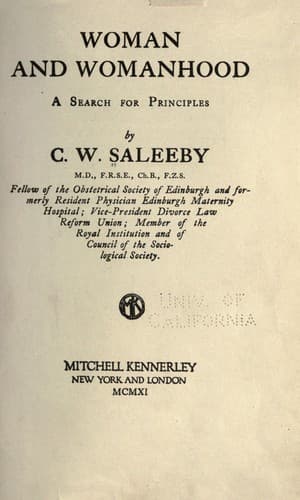
Woman and Womanhood: A Search for PrinciplesSaleeby, C. W. (Caleb Williams)
Science
Woman and Womanhood: A Search for Principles
Saleeby, C. W. (Caleb Williams)
Eugenics; Women
For instance, there is the well-established fact that women who have
undergone "higher education" show a low marriage-rate, and produce very
few children. However considered, the fact is of great importance. But
the right interpretation of it is not certain. There are women of a type
approaching the masculine, who are evidently so by nature. Is it these
women, already predestined for something other than distinctive
womanhood, that offer themselves for "higher education"? In other words,
is there a selective process at work, the results of which in choosing a
certain type of woman we attribute to the education undergone? If we
answer this question wrongly, and act upon our erroneous interpretation,
we shall certainly do grave injury to individuals and society.
Thus, we might roundly condemn the higher education of women _in toto_,
and hold up the "domestic woman" as the sole type to which every woman
can and must be made to conform. Or, on the other hand, we may argue
that it is well to provide suitable opportunities of self-development
for those women whose nature practically unfits them for the ordinary
career of a woman.
I do not think that any one who has had opportunities of first-hand
observation will question the presence in university and college
class-rooms of girls of the anomalous type. Each generation produces a
certain number of such. Probably no education will alter their nature in
any radical or effective way. On every ground, personal and social, we
must be right in providing for them, as for their brothers, all the
opportunities they may desire. But I am convinced that their relative
number is not large.
The great majority of those girls who are nowadays subjected to what we
call "higher education" are of the normal type; and this is none the
less true because the proportion of the anomalous is doubtless higher
here than in the feminine community at large. The ordinary observation
of those teachers who year by year see young girls at the beginning of
their higher education will certainly confirm the statement that by far
the greater number of them are of the ordinary feminine type. If this be
so, the necessary inference is that education _has_ a potent influence,
and that it must be held accountable for the observed facts of later
years, whether those facts please or displease us.
Public-domain text, read in full here on John Shaqi.
Reviews
Reviews
No reviews yet
Be the first to share your thoughts on this work.
Join the Discussion
Join the discussion
Sign in to leave a comment or review.
Sign InorCreate an account