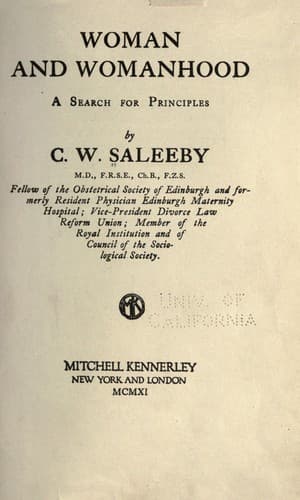
Woman and Womanhood: A Search for PrinciplesSaleeby, C. W. (Caleb Williams)
Science
Woman and Womanhood: A Search for Principles
Saleeby, C. W. (Caleb Williams)
Eugenics; Women
This question of compatibilities is illustrated very strikingly by the
case of the worker-bee. There is as yet no purely Mendelian
interpretation of this case, Mendel's own laborious work upon heredity
in bees having been entirely lost, and practically nothing having been
done since. Yet, as will be evident, the main argument of Geddes and
Thomson leads us to a similar interpretation of this case in terms of
compatibility.
The worker-bee is an individual of a most remarkable and admirable kind,
from whom mankind have yet a thousand truths to learn. She is
distinguished primarily by the rare and high development of her nervous
apparatus. In terms of brain and mind, using these words in a general
sense, the worker-bee is almost the paragon of animals. The ancients
supposed that the queen-bee was indeed the queen and ruler of the hive.
Here, they thought, was the organizing genius, the forethought, the
exquisite skill in little things and great, upon which the welfare of
the hive and the future of the race depend. But, in point of fact, the
queen-bee is a fool. Her brain and mind are of the humblest order. She
never organizes anything, and does not rule even herself, but does what
she is told. She is entirely specialized for motherhood; but the
thinking, and the determination of the conditions of her motherhood, are
in the hands of other females, also highly specialized, and certainly
the least selfish of living things--_yet themselves sterile, incapable
of motherhood_.
Observe, further, that these wonderful workers, so highly endowed in
terms of brain, are amongst the children of the queen, herself a fool;
and that it was the conditions of nourishment, the conditions of
environment or education, which determined whether the young creatures
should develop into queens or workers, fertile fools or sterile wits. We
have here an absolute demonstration that environment or nurture can
determine the production of these two antithetic and radically opposed
types of femaleness.
Now, amongst the bees, this high degree of specialization works very
well. How old bee-societies are we cannot say. We do know, at any rate,
that bees are invertebrate animals, and therefore of immeasurable
antiquity compared with man. No one can for a moment question the
eminent success of the bee-hive; and that success depends upon the
extreme specialization of the female, so as in effect to create a third
sex. Further, we know that nurture alone accounts for this remarkable
splitting of one sex into two contrasted varieties.
Public-domain text, read in full here on John Shaqi.
Reviews
Reviews
No reviews yet
Be the first to share your thoughts on this work.
Elsewhere in the archive
Join the Discussion
Join the discussion
Sign in to leave a comment or review.
Sign InorCreate an account