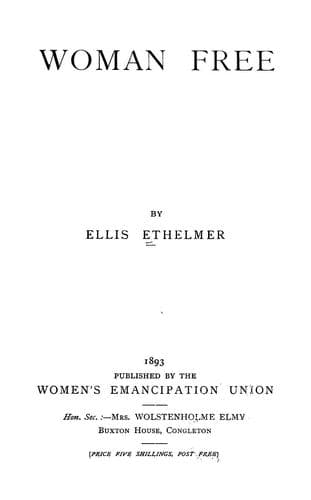
English poetry -- 19th century; Women -- History; Women -- Social conditions; Women -- Suffrage
The italics, as above, exist in the original (with the exception of
those in Par. 3), and serve, singularly enough, to point for us a moral
very much deeper than that intended. It is a happy fact that British
feeling, supported by the growing sentiment of the more intelligent and
educated of the native population, has effected even so slight an
amelioration of law and custom, and we may hope for and press forward to
further improvement. Though the utterance quoted above is only that of
the Mahomedan section, it is, of course, understood that the law does
not apply or point to them alone, but to all the peoples and sects of
India; and that the approval of this legislation is also general among
the enlightened of those other creeds. (See end of Note XVII., 8.)
Singular confirmatory evidence as to the distressing prevalence of this
child-marriage is incidentally given in the following paragraph from the
_Times_ of 31st March, 1892:—
“A correspondent of the _Times of India_ mentions some odd instances
of minor difficulties which have occurred in the working of the
amended Factory Act, which came into force in India at the
commencement of the present year. The limit of age for ‘full-timers’
in factories is fixed at fourteen years, and as very few native
operatives know their children’s ages, or even their own, the medical
officer has, in passing lads and girls for work, to judge the age as
best he can—generally, as in the case of horses, by examining their
teeth. If he concludes that they are under fourteen, he reduces them
to ‘half-timers.’ In one Bombay mill recently a number of girls were
thus sent back as under age who were actually mothers, and several
boys who were fathers were also reduced; and one of the latter was the
father, it is said, of three children. The case of these lads is
particularly hard, for, with a wife and child, or perhaps children, to
support, life, on the pay of a ‘half-timer,’ must be a terrible
struggle.”
Public-domain text, read in full here on John Shaqi.
Reviews
Reviews
No reviews yet
Be the first to share your thoughts on this work.
Join the Discussion
Join the discussion
Sign in to leave a comment or review.
Sign InorCreate an account