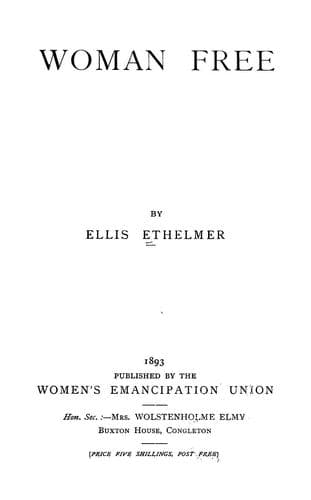
English poetry -- 19th century; Women -- History; Women -- Social conditions; Women -- Suffrage
_Id._... “From one philosophical point of view, that of Du Prel, the
experiments are already regarded as proving that the soul is an
organising as well as a thinking power.... Bernheim saw an apoplectic
paralysis rapidly improved by suggestion.... The more easily an idea can
be established in the subject, the quicker a therapeutic result can be
induced.... I think that hardly any of the newest discoveries are so
important to the art of healing, apart from surgery, as the study of
suggestion.... Now that it has been proved that even organic changes can
be caused by suggestion, we are obliged to ascribe a much greater
importance to mental influences than we have hitherto done.”—Dr. Albert
Moll (“Hypnotism,” pp. 122, 318, 320, 325, 327).
_Id._... “It would, I fancy, have fared but ill with one who, standing
where I now stand, in what was then a thickly-peopled and fashionable
part of London, should have broached to our ancestors the doctrine which
I now propound to you—that all their hypotheses were alike wrong; that
the plague was no more, in their sense, Divine judgment, than the fire
was the work of any political, or of any religious, sect; but that they
were themselves the authors of both plague and fire, and that they must
look to themselves to prevent the recurrence of calamities, to all
appearance so peculiarly beyond the reach of human control.... We, in
later times, have learned somewhat of Nature, and partly obey her.
Because of this partial improvement of our natural knowledge and of that
fractional obedience, we have no plague; because that knowledge is still
very imperfect and that obedience yet incomplete, typhus is our
companion and cholera our visitor. But it is not presumptuous to express
the belief that, when our knowledge is more complete and our obedience
the expression of our knowledge, London will count her centuries of
freedom from typhus and cholera as she now gratefully reckons her two
hundred years of ignorance of that plague which swooped upon her thrice
in the first half of the seventeenth century.”—T. H. Huxley (“On
Improving Natural Knowledge”).
And the pestilent malady from which woman specially still suffers is as
definitely the result of man’s ignorant or thoughtless misdoing, and is
as indubitably amenable to rectification, as the plague of the bye-gone
ages, or the typhus and cholera of the present.
8.—“... _pain both prompts and points escape_.”
“All evil is associated more or less closely with pain ... and pain of
every kind is so repugnant to the human organism, that it is no sooner
felt than an effort is made to escape from it.... Alongside of the
evolution of evil there has ever been a tendency towards the
_elimination_ of evil.... The highest intellectual powers of the
greatest men have for their ultimate object the mitigation of evil, and
the final elimination of it from the earth.”—Richard Bithell (“The Creed
of a Modern Agnostic,” p. 103).
XXIX.
Public-domain text, read in full here on John Shaqi.
Reviews
Reviews
No reviews yet
Be the first to share your thoughts on this work.
Elsewhere in the archive
Join the Discussion
Join the discussion
Sign in to leave a comment or review.
Sign InorCreate an account