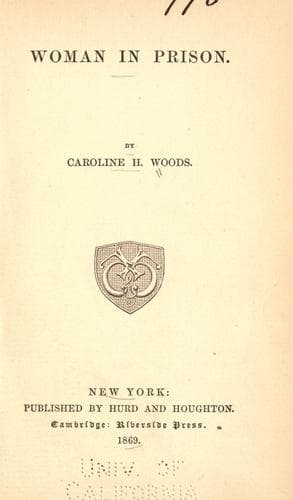
Prisons -- United States; Women prisoners -- United States
I asked myself if it were possible that that man would dare to abuse the
trust reposed in him in that manner. Certainly! The whole system of
secrecy upon which our prisons are managed is just calculated to screen
such conduct, and to induce the practice of it, if there be a tendency,
in the disposition of the man who has charge, to do it. If the testimony
of prisoners is not to be relied upon, a Master could make it for the
interest of his officers to remain silent. Some might look at it in the
same light that he did, and feel perfectly satisfied.
Why should not a prisoner's testimony be taken in a matter where he is
concerned? He has been tried and convicted of an offense. Is that fact a
conviction in every other case where he may have difficulty with another
person?
If prisoners are entirely unworthy of trust, how does it happen that
such a man, once a convict himself, according to the traditions of that
prison, has charge there, and the unlimited confidence of the Board?
I noticed, in making out the report of inmates, that there were not so
many women as men in prison. There was satisfaction in obtaining that
fact, because I had entertained the idea that women were more frequently
punished for their offenses than men.
It was a mistake, except in the one crime of licentiousness. In that man
goes comparatively free, and woman is the only sufferer in what is, to
say the least, their mutual sin. I say, almost every woman will say, and
with truth, for the sin that man leads her into.
Woman does not seek man, in that way, in the first instance. He draws
her into the sin, and when she becomes abandoned, and the Penitentiary
brings her up, she is no worse than he. She becomes a night-walker, and
suffers for her violation of law. He is a night-walker also, as
miserable and degraded a man as she is woman; but who prosecutes him,
and gives him a sentence in the House of Correction! He continues a
night-walker unmolested while she suffers for her sin.
He walks into the parlors of the intellectually cultivated, and socially
refined,--I was about to say virtuous woman. There can be little virtue
in such shaky morality. I can only say of the chaste woman, and she
takes the hand of the night-walker, and greets him cordially, and makes
him welcome, especially if he be rich,--the hand that leads her fellow
woman to her social ruin if not to her eternal death.
If woman were to help make the laws, could she remedy this state of
things,--would she? Would she take her husband, father, brother from his
home to the Penitentiary? She must do that, in order to rid society of
the pest of night-walking. She may do that now if she will. The law
gives her the opportunity. Instead of lavishing her courtesies, as she
now does, upon the male offender, she might extend her charity in kindly
assistance to his victim, if she were disposed to do it.
Public-domain text, read in full here on John Shaqi.
Reviews
Reviews
No reviews yet
Be the first to share your thoughts on this work.
Join the Discussion
Join the discussion
Sign in to leave a comment or review.
Sign InorCreate an account