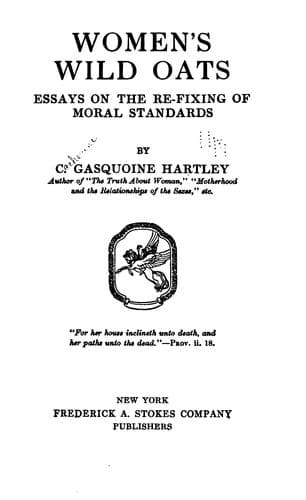
Women's Wild Oats: Essays on the Re-fixing of Moral StandardsHartley, C. Gasquoine (Catherine Gasquoine)
History
Women's Wild Oats: Essays on the Re-fixing of Moral Standards
Hartley, C. Gasquoine (Catherine Gasquoine)
Women -- Great Britain; Women -- Social and moral questions
All forcing of goodness, in my opinion, is dangerous. Often the cause of
virtue is injured, like the cause of religion, not only when virtue is
allied with routine, dullness and narrowness, but also when appeal is
made to aspirations, which the young rarely feel spontaneously,
aspirations ill-adapted and too high for their immature characters and
the needs at the stage of virtue that has been reached. Certainly they
_appear_ to respond, fall in with our plans of salvation and often
accept them with seeming joy; I venture, however, to think that very
often this external attitude does not in any way correspond with the
internal one, that very often there has been disturbance and shock, to
be followed later by increased need for excitement, with an impulse to
more perilous adventure to cover the unconscious feeling of frustration
and disappointment; while another result is a sense of unreality, a
state always unfavorable to moral health.
If morality is seen as something overbeautiful for daily use, even more
than as something dull, inactive, over-prudent; if vice, on the other
hand, is conceived as easy, brilliant, gay, gallantly reckless, in
opposition to the too ethereal or merely stupid and prosaic aspects of
life (though in reality seldom do the dissipated and those who prey on
the vices of mankind possess any brilliance or originality), then beauty
and virtue will aid vice, through the stimulus of contradiction it will
provide. Vice will gain by the brilliance, wit and beauty, which the
artists and creators of the world ought to be induced, were the world's
cause properly cared for, to connect with virtue.
The popular view of our common motives still inclines to reduce
everything to a single impulse--the young are moved exclusively by
self-interest and the search for pleasure. But surely this view is
false. Hazlitt, the English essayist most interested in psychology, in
his essay on "Mind and Motive," correctly observes that, "love of strong
excitement both in thought and action" has much more influence on our
ideas, passions and pursuits than mere desire for the agreeable.
Curiosity itself, also the love of truth, "our teasing ourselves to
recollect the names of persons and places we have forgotten, the love of
riddles and of abstruse philosophy," he holds these to be illustrations
of "the love of intellectual excitement," and, with respect to this
curiosity, he holds that our vices are more due to it than to sexual
gratifications, saying with regard to vicious habits, "curiosity makes
more votaries than inclination."
Public-domain text, read in full here on John Shaqi.
Reviews
Reviews
No reviews yet
Be the first to share your thoughts on this work.
Join the Discussion
Join the discussion
Sign in to leave a comment or review.
Sign InorCreate an account