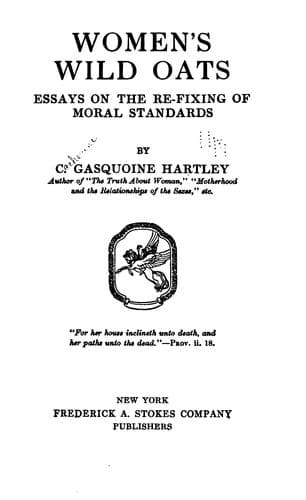
Women's Wild Oats: Essays on the Re-fixing of Moral StandardsHartley, C. Gasquoine (Catherine Gasquoine)
History
Women's Wild Oats: Essays on the Re-fixing of Moral Standards
Hartley, C. Gasquoine (Catherine Gasquoine)
Women -- Great Britain; Women -- Social and moral questions
The first school favors extreme State interference. Persons suspected of
disseminating disease (or "denounced by one of the opposite sex" as
having done so) are liable to be arrested, medically examined, and, if
necessary, detained for re-examination and for treatment until cured:
habitual prostitutes can be sentenced to imprisonment. Possibly
State-inspected brothels will be established; all street solicitation
treated as an offense. Compulsory medical certificates of freedom from
infectious venereal diseases will be made a legal prerequisite of
marriage; all wishing to be married, when found infected, to be
registered and treated until certified free from infection. State
provision of hygienic preventative and curative means are to be given
free to those in danger from infection as well as to all suffering from
venereal diseases. Finally, severe police action is urged against
agents, landlords, publicans, restaurant and hotel-keepers, theater,
music-hall and cinema owners, fortune-tellers--and everyone directly or
indirectly profiteering by prostitution. This is not a description of
any one national treatment, or proposed treatment of the problem, but
rather a composite hotch-potch, intended to include the main features of
the new and old schemes based on State interference and regulation of
vice.
The opposite school of thought produces an opposite scheme; one that I
may, perhaps, call an ethical Sunday-school plan of salvation by means
of guidance and gentle persuasions. They would educate people in the
fact that all _promiscuous intercourse is likely to be dangerous_, and
recommend only an alteration of the laws of marriage and divorce to meet
cases of marital infection and to protect children who are infected by
negligence. Such a course of mild action is widely supported by bishops
and by "sheltered" women, who reveal to us curiously the psychology of
the class, which, throughout the Victorian period, practiced idealism on
the easiest methods.
Public-domain text, read in full here on John Shaqi.
Reviews
Reviews
No reviews yet
Be the first to share your thoughts on this work.
Join the Discussion
Join the discussion
Sign in to leave a comment or review.
Sign InorCreate an account