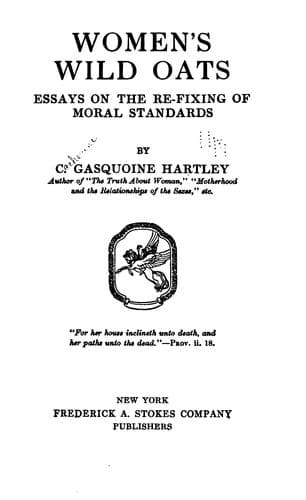
Women's Wild Oats: Essays on the Re-fixing of Moral StandardsHartley, C. Gasquoine (Catherine Gasquoine)
History
Women's Wild Oats: Essays on the Re-fixing of Moral Standards
Hartley, C. Gasquoine (Catherine Gasquoine)
Women -- Great Britain; Women -- Social and moral questions
"_It is evident that placing the houses at Blois out of bounds
has had a wonderful effect, not only in lowering the venereal
rate, but in improving the morality of the soldiers and also
of the civil population._"
Of course, these few figures and scattered facts cannot tell the whole
story; they do, however, indicate with sufficient clearness what may be
done by firm and fearless action.
V
Let me try to make the position clearer by means of another and quite
different illustration. The results of restrictions on the drink trade
in England during the war showed that legislative interference with
strict rules can do much more than many of us believed.[134:1] Wipe off
all that is doubtful in the results, all evasions of the law, all that
was due to the absence of a large number of healthy men, yet the State
interference--prohibition of treating, great shortening of hours,
provision of weakened beer--these undoubtedly have acted so as to reduce
drunkenness.
Surely this must serve as a great proof that the removal of temptation
is the one effective remedy to help men and women and to prevent sin. A
man who got into trouble with a woman not very long ago, gave as a
defense in police court: "You can say 'No' to one woman, but when they
are round you all the time you can't."
The three objections specially urged by women against laws directed
against prostitution and prohibiting solicitation are:--
(1) That such laws cannot prevent all solicitation. This may be granted,
but it does not prove that they may not greatly lessen the evil of
solicitation. It may be granted, in the same way, that no State
prohibition can prevent all secret drinking. But this is no reason for
or against prohibition; the question is what it does do, not what it
does not do.
(2) That such laws act unequally for the two sexes,--that is, that a man
is never, or almost never, made specially liable for soliciting and
worrying women. This objection is really quite absurd, and it is only on
account of the frequency with which it is urged by women that I refer to
it again. For the life of me, I cannot see how any woman reconciles it
with her conscience to bring forward such a silly evasion. A woman can
always give a man in charge who annoys and insults her; moreover, in the
vast majority of cases she could without effort protect herself from any
such annoyance. Laughter is a weapon that will dishearten the most
persistent man-follower. Besides, as every one of us knows, solicitation
is the woman's act, and not the man's in ninety-nine out of a hundred of
these cases. The man may be ready, possibly he may seek, but he seeks
only where he knows the one sought will invite. This objection cannot
then, in honesty, stand.
Public-domain text, read in full here on John Shaqi.
Reviews
Reviews
No reviews yet
Be the first to share your thoughts on this work.
Elsewhere in the archive
Join the Discussion
Join the discussion
Sign in to leave a comment or review.
Sign InorCreate an account