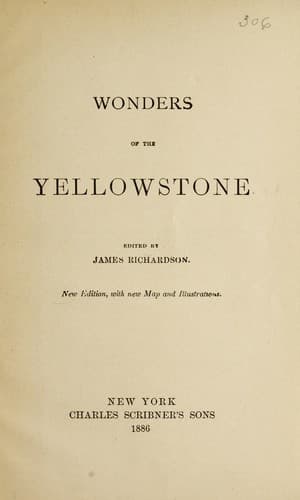
Wonders of the YellowstoneRichardson, James (Geologist)
History
Wonders of the Yellowstone
Richardson, James (Geologist)
Yellowstone National Park
"Although I searched with diligence and care in the neighboring
streams and waters around the Yellowstone Lake, I was unable to find
any other species of fish except the salmon-trout; their numbers are
almost inconceivable; average weight, one pound and a half; color, a
light-grey above, passing into a light-yellow below; the fins, all
except the dorsal and caudal, vary from a bright-yellow to a brilliant
orange, they being a dark-grey and heavily spotted. A curious fact, and
one well worthy of the closest attention of an aspiring icthyologist,
is connected with these fish, namely, that among their intestines, and
even interlaced in their solid flesh, are found intestinal worms,
varying in size, length, and thickness, the largest measuring about six
inches in length. On cutting one of these trout open, the first thing
that attracts your attention is small oleaginous-looking spots clinging
to the intestines, which, on being pressed between the fingers, break
and change into one of these worms, small, it is true, but nevertheless
perfect in its formation. From five or six up to forty or fifty will
be found in a trout, varying, as I said before, in size, the larger
ones being found in the solid flesh, through which they work their way,
and which, in a very short while, becomes almost putrid. Their number
can generally be estimated from the appearance of the fish itself; if
many, the trout is extremely poor in flesh, the color changes from the
healthy grey to a dull pale, it swims lazily near the top of the water,
losing all its shyness and fear of man; it becomes almost savage in its
appetite, biting voraciously at anything thrown in the water, and its
flesh becomes soft and yielding. If, on the other hand, there are few
or none, the flesh of the fish is plump and solid, and he is quick and
sprightly in all his motions. I noticed that it was almost invariably
the case when a trout had several scars on the outside of his body that
it was free from these worms, and I therefore took it for granted that
the worms finally worked their way through the body, and the flesh,
on healing up, leaves the scars on the outside; the trout, in a short
while, becomes plump and healthy again. The only way that I can account
for the appearance of these worms is, that the fish swallows certain
bugs or insects, and that the larvæ formed from them gradually develop
into the full-grown intestinal worm. But even if this explanation of
their appearance was received, does it not seem a little strange that
while all the fish above the Upper Falls are more or less affected by
them, that below and even between the Upper and Lower Falls such a
thing as wormy trout is never heard of? Being unable, with my limited
knowledge of icthyology, to arrive at any definite conclusion in regard
to their appearance, I submit the above facts to those who are more
learned than myself in this most interesting branch of natural history."
Public-domain text, read in full here on John Shaqi.
Reviews
Reviews
No reviews yet
Be the first to share your thoughts on this work.
Elsewhere in the archive
Join the Discussion
Join the discussion
Sign in to leave a comment or review.
Sign InorCreate an account