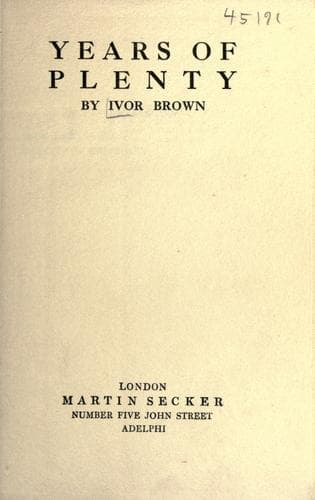
Boarding schools -- England -- Fiction; University of Oxford -- Fiction
"Of course. But it shouldn't be all. It's typical of the British
attitude. You buy your son an education costing so much, as you would
buy him a suit of clothes. They don't care twopence about the teaching
or the curriculum, except in so far as it concerns passing exams and
leads to money. Parents write about Tom's chances for Sandhurst, but
who ever writes about his classics? It's all taken for granted, even
its sickening narrowness. No one ever heard of a parent slanging the
headmaster because his son didn't know who wrote _The Alchemist_ or
because he thought Chopin was a music hall comedian."
"Do you suppose," asked Martin, "that fifty per cent of the Elfreyan
parents know there is a play called _The Alchemist_?"
"Well, I wouldn't bet on it," said Finney. "Still there it all is.
Ignorance and muddle. We've got so horribly linked up. Union may be
strength, but strength may be tyranny. Capital is all knotted
together. Labour soon will be, and Education is in the same way. We
can't change without the others changing, the others can't change
without the varsities----"
"And the varsities won't change till public opinion blows them to
bits," added Martin. "So it all comes back to the dear old _vox
populi_."
"I suppose so," said Finney wearily. "Come and have some tea."
Although he found Finney's suggestions disappointing, Martin continued
to ponder occasionally on the phenomena of school life, and when he
went to Devonshire for the Easter holidays he took the opportunity of
questioning his uncle, for whose views he had a great respect. John
Berrisford was always willing to talk after his third glass of port and
he welcomed Martin's questions.
"Of course you know," he said, "that though I'm a revolutionary in
politics and economics, I'm a sound Tory about institutions and the
things that matter, like beef and beer. So I believe in the Public
Schools and the Universities, not because they're good, but because
they _are_. Everything that is, must be an expression of human nature,
and, being rather an optimist, I think it has some good in it. Anyhow,
we can't take human nature and twist it about, as social reformers want
to do. The people who cry out for Censors of Art seem to imagine that
Art makes public opinion. It may do so now and then, but it's much
more important to realise that public opinion makes current art. Art
is the emergence of what people are feeling and thinking, and our
schools, like our art, must be an expression of the national self."
"But the national self," said Martin, "is pretty stiff."
Public-domain text, read in full here on John Shaqi.
Reviews
Reviews
No reviews yet
Be the first to share your thoughts on this work.
Elsewhere in the archive
Join the Discussion
Join the discussion
Sign in to leave a comment or review.
Sign InorCreate an account