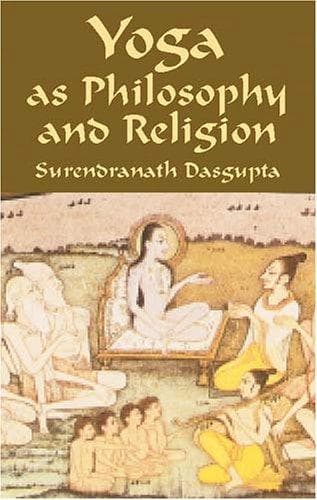
Yoga as philosophy and religionDasgupta, Surendranath
Religion
Yoga as philosophy and religion
Dasgupta, Surendranath
Hindu philosophy; Patañjali; Yoga
This sense of hearing, then, having its origin in the principle of
ahaṃkāra, behaves like iron, and is drawn by the sounds originated and
located in the mouth of the speaker acting as loadstone, and transforms
them into its own successive modifications (_vṛtti_) and thus senses the
sounds of the speaker. And it is for this reason that for every living
creature, the perception of sound in external space in the absence of
defects is never void of authority. Thus Pancasikha also says, as quoted
in _Vyāsa-bhāshya_, III. 41:
“To all those whose organs of hearing are situated in the same place (at
different times) the ākāśa sustaining the sense of hearing is the same.”
The ākāśa, again, in which the power of hearing is seated, is born out
of the soniferous tanmātra, and has therefore the quality of sound
inherent in itself. It is by this sound acting in unison that it takes
the sounds of external solids, etc. This then proves that the ākāśa is
the substratum of the power of hearing, and also possesses the quality
of sound. And this sameness of the situation of sound is an indication
of the existence of ākāśa as that which is the substratum of the
auditory power (_śruti_) which manifests the sounds of the same class in
ākāśa. Such a manifestation of sound cannot be without such an auditory
sense-power. Nor is such an auditory power a quality of pṛthivī (earth),
etc., because it cannot be in its own self both the manifestor and the
manifested (_vyahṅgya_ and _vyañjaka_), _Tattvavaiśāradī_, III. 41. It
is the auditory power which manifests all sounds with the help of the
ākāśa of the sense organ.
The theory of the guṇas was accepted by many others outside the
Sāṃkhya-Yoga circle and they also offered their opinions on the nature
of the categories.
There are thus other views prevalent about the genesis of the senses, to
which it may be worth our while to pay some attention as we pass by.
The sāttvika ego in generating the cognitive senses with limited powers
for certain specified objects of sense only accounted for their
developments from itself in accompaniment with the specific tanmātras.
Thus
sāttvika ego + sound potential (śabda-tanmātra) = sense of hearing.
sāttvika ego + touch potential (śparś-tanmātra) = sense of touch.
sāttvika ego + sight potential (śrūpa-tanmātra) = sense of vision.
sāttvika ego + taste potential (vasa-tanmātra) = sense of taste.
sāttvika ego + smell potential (gandha-tanmātra) = sense of smell.
The conative sense of speech is developed in association with the sense
of hearing; that of hand in association with the sense of touch; that of
feet in association with the sense of vision; that of upastha in
association with the sense of taste; that of pāyu in association with
the sense of smell.
Last of all, the manas is developed from the ego without any
co-operating or accompanying cause.
Public-domain text, read in full here on John Shaqi.
Reviews
Reviews
No reviews yet
Be the first to share your thoughts on this work.
Join the Discussion
Join the discussion
Sign in to leave a comment or review.
Sign InorCreate an account