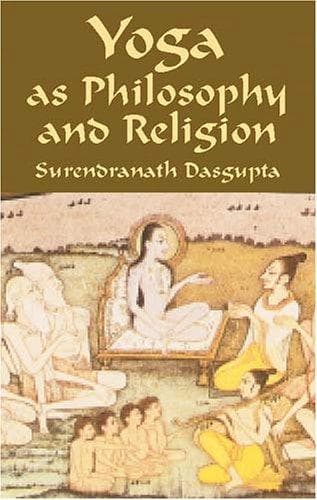
Yoga as philosophy and religionDasgupta, Surendranath
Religion
Yoga as philosophy and religion
Dasgupta, Surendranath
Hindu philosophy; Patañjali; Yoga
Nāgeśa, however, takes a slightly different view and says that to
produce the gross atoms from the tanmātras, an accretion of bhūtādi as
an accompanying agent is necessary at every step; so that we see that
the vāyu atom is produced from these three: śabda + sparśa + accretion
from bhūtādi. Tejas atom = śabda + śparśa + rūpa + accretion from
bhūtādi. Ap atom = śabda + śparśa + rūpa + rasa + accretion from
bhūtādi. Kshiti atom = śabda + śparśa + rūpa + rasa + gandha + accretion
from bhūtādi.
I refrain from giving the _Vishṇu Purāṇa_ view which has also been
quoted in the _Yoga-vārttika_, and the view of a certain school of
Vedāntists mentioned in the _Tattva-nirūpaṇa_ and referred to and
described in the _Tattvatraya_, as Dr. B. N. Seal has already described
them in his article.
We see thus that from bhūtādi come the five tanmātras which can be
compared to the Vaiśeshika atoms as they have no parts and neither
grossness nor visible differentiation.[31] Some differentiation has of
course already begun in the tanmātras, as they are called śabda, śparśa,
rūpa, rasa and gandha, which therefore may be said to belong to a class
akin to the grosser elements of ākāśa, vāyu, tejas, ap and kshiti.[32]
The next one, the paramāṇu (atom), which is gross in its nature and is
generated from the tanmātras which exist in it as parts
(_tanmātrāvayava_) may be compared with the trasareṇu of the
Vaiśeshikas. Thus the _Yoga-vārttika_ says: “this is called paramāṇu by
the Vaiśeshikas. We however call the subtlest part of the visible earth,
earth atoms” (IV. 14). The doctrine of atoms is recognised both in the
_Yoga-sūtrās_ (I. 46) and the _Bhāshya_ (III. 52, IV. 14, etc.).
Whether Sāṃkhya admitted the paramāṇus (atoms) or not cannot be
definitely settled. The _Sāṃkhya-kārikā_ does not mention the paramāṇus,
but Vijñāna Bhikshu thinks that the word “_sūkshma_” in _Kārikā_, 39,
means paramāṇus (_Yoga-vārttika_, IV. 14). Though the word paramāṇu is
not mentioned in the _Kārikā_, I can hardly suppose that Sāṃkhya did not
admit it in the sense in which Yoga did. For it does not seem probable
that Sāṃkhya should think that by the combination of the subtle
tanmātras we could all at once have the bigger lumps of bhūta without
there being any particles. Moreover, since the Yoga paramāṇus are the
finest visible particles of matter it could not have been denied by
Sāṃkhya. The supposition of some German scholars that Sāṃkhya did not
admit the paramāṇus does not seem very plausible. Bhikshu in
_Yoga-vārttika_, III. 52, says that the guṇas are in reality Vaiśeshika
atoms.
Public-domain text, read in full here on John Shaqi.
Reviews
Reviews
No reviews yet
Be the first to share your thoughts on this work.
Elsewhere in the archive
Join the Discussion
Join the discussion
Sign in to leave a comment or review.
Sign InorCreate an account