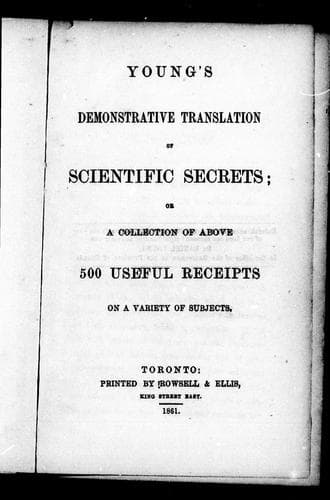
Young's Demonstrative Translation of Scientific Secrets: Or, A Collection of Above 500 Useful Receipts on a Variety of SubjectsYoung, Daniel
Science
Young's Demonstrative Translation of Scientific Secrets: Or, A Collection of Above 500 Useful Receipts on a Variety of Subjects
Young, Daniel
Formulas, recipes, etc.; Science -- Methodology
The following rules will enable any man to ascertain with tolerable
certainty the age of any horse. Every horse has six teeth above and
six below; before he arrives at the age of three he sheds his two
middle teeth by the young teeth rising and shoving the old ones out
of their place. When he arrives at the age of three, he sheds one
more on each side of the middle teeth; when four years old he sheds
two corner and the last of his fore teeth; between four and five he
cuts his under tusks, and when five will cut his upper tusks, and
have a mouth full and complete, and the teeth will have hollows of a
very dark brown colour. At six years old the grooves and hollows in
a horse's mouth will begin to fill up a little and their tusks have
their full growth, with their points sharp, and a little concave. At
seven years old the grooves and hollows will be pretty well filled
below. At eight the whole of the hollows and groves are filled up,
and you see the appearance of what is termed smooth below. At nine
years old, the point of the tusk is worn off, and the part that was
concave begins to fill up and become rounded. Between nine and ten
years of age a horse generally looses the marks of the mouth. After
nine years old a wrinkle comes on the eyelid at the upper corner of
the lower lid, and every year thereafter he has one well defined
wrinkle for each year over nine. If, for instance, a horse has
three wrinkles, he is twelve; if four, he is thirteen, &c.
329. HEAD, NECK OR LUNGS
How to tell by looking at a horse whether there is anything the
matter with his head, neck or lungs. A knowledge of this is as
useful as it is simple. If there is nothing the matter with the
head, neck or lungs of a horse, the nostrils will have a clean,
healthy, and bright appearance, but if there is, they have always
a dirty, muddy, or in some way an unhealthy appearance.
330. PROF. MANDIE'S HORSE TAMING
Take finely grated horse caster, or the warty excrescence from the
horse's leg, oils of rhodium, and cumin, keep these in separate
bottles well corked; put some of the oil of cumin on your hand and
approach the horse on the windy side that he may smell it; he will
then move towards you, then rub some of the cumin on his nose; give
him a little of the castor on sugar, salt, or anything he likes,
and get 8 or 10 drops of the oil of rhodium on the point of his
tongue; you can then get him to do anything you please. Follow up
your advantage by all the kindness and attention possible towards
the animal, and your control is certain. This is only fit for
nervous horses; but the railroad system is certain. In all kinds
of ugly horses it is the best of methods.
331. BOTTS IN HORSES
Public-domain text, read in full here on John Shaqi.
Reviews
Reviews
No reviews yet
Be the first to share your thoughts on this work.
Elsewhere in the archive
Join the Discussion
Join the discussion
Sign in to leave a comment or review.
Sign InorCreate an account