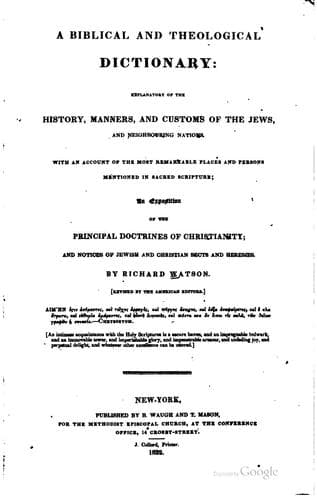
A Biblical and Theological Dictionary: explanatory of the history, manners, and customs of the Jews, and neighbouring nationsWatson, Richard
Religion
A Biblical and Theological Dictionary: explanatory of the history, manners, and customs of the Jews, and neighbouring nations
Watson, Richard
Bible -- Dictionaries; Theology -- Dictionaries
Antiochus followed Tryphon, till he forced him to kill himself in the
year of the world 3869. After this, Antiochus thought only of reducing
to his obedience those cities which, in the beginning of his father’s
reign, had shaken off their subjection. Simon Maccabæus, prince and high
priest of the Jews, being treacherously murdered by Ptolemy, his
son-in-law, in the castle of Docus, near Jericho, the murderer
immediately sent to Antiochus Sidetes to demand troops, that he might
recover for him the country and cities of the Jews. Antiochus came in
person with an army, and besieged Jerusalem, which was bravely defended
by John Hircanus. The siege was long protracted; and the king divided
his army into seven parts, and guarded all the avenues of the city. It
being the time for celebrating the feast of tabernacles, the Jews
desired of Antiochus a truce for seven days. The king not only granted
this request, but sent them bulls with gilded horns, and vessels of gold
and silver filled with incense, to be offered in the temple. He also
ordered such provisions as they wanted, to be given to the Jewish
soldiers. This courtesy of the king so won the hearts of the Jews, that
they sent ambassadors to treat of peace, and to desire that they might
live according to their own laws. Antiochus required that they should
surrender their arms, demolish the city walls, pay tribute for Joppa and
the other cities they possessed out of Judea, and receive a garrison
into Jerusalem. To these conditions, except the last, the Jews
consented; for they could not be induced to see an army of strangers in
their capital, and chose rather to give hostages and five hundred
talents of silver. The king entered the city, beat down the breast work
above the walls, and returned to Syria, in the year of the world 3870,
and before Jesus Christ 134. Three years after, Antiochus marched
against the Persians, or Parthians, and demanded the liberty of his
brother Demetrius Nicanor, who had been made prisoner long before by
Arsaces, and was detained for the purpose of being employed in exciting
a war against Antiochus. This war, therefore, Antiochus thought proper
to prevent. With an army of eighty thousand, or, as Orosius says, of one
hundred thousand men, he marched toward Persia, and no sooner appeared
on the frontiers of that country, than several eastern princes,
detesting the pride and avarice of the Persians, came and surrendered.
Antiochus defeated his enemies in three engagements, and took Babylon.
He was accompanied in these expeditions by John Hircanus, high priest of
the Jews, who, it is supposed, obtained the surname of Hircanus from
some gallant action which he performed.
Public-domain text, read in full here on John Shaqi.
Reviews
Reviews
No reviews yet
Be the first to share your thoughts on this work.
Elsewhere in the archive
Join the Discussion
Join the discussion
Sign in to leave a comment or review.
Sign InorCreate an account