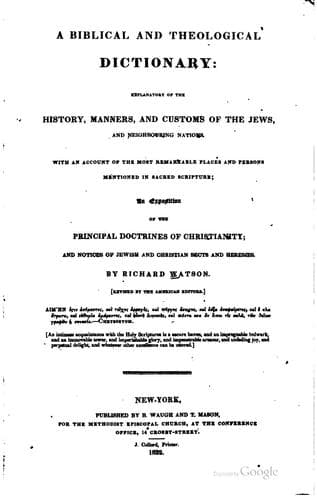
A Biblical and Theological Dictionary: explanatory of the history, manners, and customs of the Jews, and neighbouring nationsWatson, Richard
Religion
A Biblical and Theological Dictionary: explanatory of the history, manners, and customs of the Jews, and neighbouring nations
Watson, Richard
Bible -- Dictionaries; Theology -- Dictionaries
After the resurrection of our Saviour, and not long before his
ascension, the place of Judas the traitor was supplied by Matthias,
supposed by some to have been Nathanael of Galilee, to whom our Lord had
given the distinguishing character of an “Israelite indeed, in whom
there was no guile;” and the twelve Apostles, whose number was now
completed, received a new commission, of a more extensive nature than
the first, to preach the Gospel to all nations, and to be witnesses of
Christ, not only in Jerusalem, in all Judea, and in Samaria, but unto
the uttermost parts of the earth; and they were qualified for the
execution of their office by a plenteous effusion of miraculous powers
and spiritual gifts, and particularly the gift of tongues. In
consequence of this commission, they preached first to the Jews, then to
the Samaritans, and afterward to the idolatrous Gentiles. Their signal
success at Jerusalem, where they opened their commission, alarmed the
Jewish sanhedrim, before which Peter and John were summoned, and from
which they received a strict charge never more to teach, publicly or
privately, in the name of Jesus of Nazareth. The noble reply and
subsequent conduct of the Apostles are well known. This court of the
Jews was so awed and incensed, as to plot the death of the twelve
Apostles, as the only effectual measure for preventing the farther
spread of Christianity. Gamaliel interposed, by his prudent and moderate
counsel; and his speech had so good an effect upon the sanhedrim, that,
instead of putting Peter and John to death, they scourged them, renewed
their charge and threats, and then dismissed them. The Apostles,
however, were not discouraged nor restrained; they counted it an honour
to suffer such indignities, in token of their affection to their Master,
and zeal in his cause; and they persisted in preaching daily in the
courts of the temple, and in other places, that Jesus of Nazareth was
the promised and long expected Messiah. Their doctrine spread, and the
number of converts in Jerusalem still increased. During the violent
persecution that raged at Jerusalem, soon after the martyrdom of St.
Stephen, several of the leading men among the Christians were dispersed;
some of them travelled through the regions of Judea and Samaria, and
others to Damascus, Phœnicia, the Island of Cyprus, and various parts
of Syria; but the twelve Apostles remained, with undaunted firmness, at
Jerusalem, avowing their attachment to the persecuted interest of
Christ, and consulting how they might best provide for the emergencies
of the church, in its infant and oppressed state.
Public-domain text, read in full here on John Shaqi.
Reviews
Reviews
No reviews yet
Be the first to share your thoughts on this work.
Elsewhere in the archive
Join the Discussion
Join the discussion
Sign in to leave a comment or review.
Sign InorCreate an account