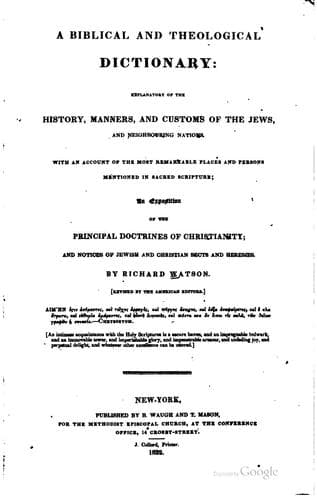
A Biblical and Theological Dictionary: explanatory of the history, manners, and customs of the Jews, and neighbouring nationsWatson, Richard
Religion
A Biblical and Theological Dictionary: explanatory of the history, manners, and customs of the Jews, and neighbouring nations
Watson, Richard
Bible -- Dictionaries; Theology -- Dictionaries
“Now Daniel calls him ‘one of the chief princes,‘ or ‘one of the capital
princes,’ or ‘one of the princes that are at the head of all:’ for this
I maintain to be the full and not more than the full import of the
Hebrew words. Now we are clearly got above the earth, into the order of
celestials, who are the princes that are _first_, or _at the head of
all_? Are they any other than the three persons in the Godhead? Michael,
therefore, is one of them; but which of them? This is not left in doubt.
Gabriel, speaking of him to Daniel, calls him ‘Michael _your_ prince,’
and ‘the great prince which standeth for the children of thy people;‘
that is, not for the nation of the Jews in particular, but for the
children, the spiritual children, of that holy seed the elect people of
God; a description which applies particularly to the Son of God, and to
no one else; and in perfect consistence with this description of Michael
in the book of Daniel, is the action assigned to him in the Apocalypse,
in which we find him fighting with the old serpent, the deceiver of the
world, and victorious in the combat. That combat who was to maintain? in
that combat who was to be victorious, but the seed of the woman? From
all this it is evident, that Michael is a name for our Lord himself, in
his particular character of the champion of his faithful people, against
the violence of the apostate faction and the wiles of the devil.” To
this opinion there is nothing irreconcilable in the “voice of the
archangel” mentioned in 1 Thess. iv, 16: since the “shout,” the “voice,”
the “trump of God,” may all be the majestic summons of the Judge
himself. At the same time we must feel that the reasoning of Bishop
Horsley, though ingenious, is for from being conclusive against the
existence of one or more archangels.
ARCHBISHOP, a bishop of the first class, who superintends the conduct of
other bishops. Archbishops were not known in the east till about the
year 320; and though there were some soon after this, who had the title,
yet it was only a personal honour, by which the bishops of considerable
cities were distinguished. It was not till of late that archbishops
became metropolitans, and had suffragans under them. Athanasius appears
to have been the first who used the title archbishop, which he gave
occasionally to his predecessor. Gregory Nazianzen, in like manner, gave
it to Athanasius; not that either of them was entitled to any
jurisdiction, or even any precedency, in virtue of this title. Among the
Latins, Isidore Hispalensis is the first who speaks of archbishops.
Public-domain text, read in full here on John Shaqi.
Reviews
Reviews
No reviews yet
Be the first to share your thoughts on this work.
Elsewhere in the archive
Join the Discussion
Join the discussion
Sign in to leave a comment or review.
Sign InorCreate an account