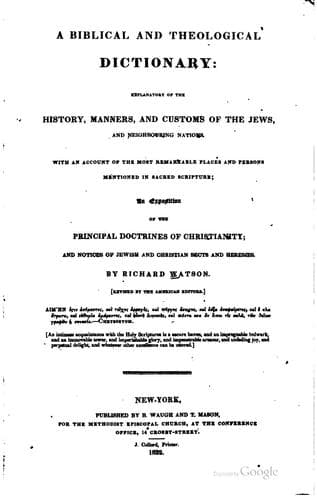
A Biblical and Theological Dictionary: explanatory of the history, manners, and customs of the Jews, and neighbouring nationsWatson, Richard
Religion
A Biblical and Theological Dictionary: explanatory of the history, manners, and customs of the Jews, and neighbouring nations
Watson, Richard
Bible -- Dictionaries; Theology -- Dictionaries
Mosheim has stated this circumstance in a note to his history of the
Arminian church; but his statement, or rather the conclusion which he
deduces from it, is evidently unfair and incorrect. He alleges, that
Arminius had actually laid the plan of that theological system which was
afterward embraced by his followers; that he had inculcated the main and
leading principles of it on the minds of his disciples; and that
Episcopius and others, who rejected Calvinism in more points than in
that which related to the divine decrees, only propagated, with greater
courage and perspicuity, the doctrines which Arminianism, as taught by
its founder, already contained. These allegations, it is clear, have no
sort of connection with the passage from which they are drawn as
inferences; and they are wholly inconsistent with the assertions, and
reasonings, and declarations of Arminius, when he is discussing the
merits of the question that was agitated between him and the Geneva
school. Arminius, in addition to the scheme of doctrine which he taught,
was anxious to establish this maxim, and to reduce it to practice, that,
with the exception above mentioned, no difference of opinions should
prevent Christians from remaining in one church or religious body. He
did not mean to insinuate, that a difference of opinion was of no
consequence at all; that they who thought one way were just as right as
they who thought a contrary way; or that men have no occasion to be
solicitous about the religious tenets which they hold. He did not mean
to give up his own system as equally true, or equally false, with that
of Calvin; and as little could he be supposed to sanction those
sentiments of his followers which were in direct opposition to the
sentiments which he himself had maintained. But he endeavoured, in the
first place, to assert liberty of conscience, and of worship; and then,
upon that fundamental principle, to persuade all Christians, however
divided in opinion, to lay aside the distinctions of sect and party, and
in one united body to consult that tranquillity and peace which is so
agreeable to the Christian name. This we conceive to have been the
object of Arminius; an object so indicative of an enlightened mind, so
congenial to that charity which hopeth all things, and thinketh no evil,
and so conducive to the interests of religion and the peace of the
world, as to reflect the highest honour on him by whom it was first
pursued, and to constitute the true glory of Arminianism.
Public-domain text, read in full here on John Shaqi.
Reviews
Reviews
No reviews yet
Be the first to share your thoughts on this work.
Elsewhere in the archive
Join the Discussion
Join the discussion
Sign in to leave a comment or review.
Sign InorCreate an account