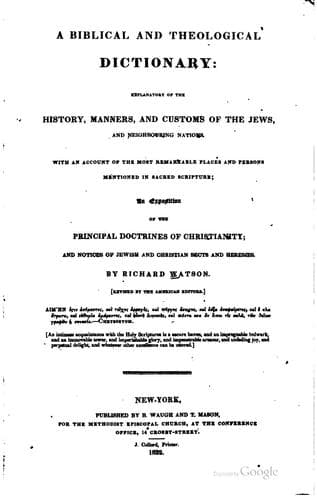
A Biblical and Theological Dictionary: explanatory of the history, manners, and customs of the Jews, and neighbouring nationsWatson, Richard
Religion
A Biblical and Theological Dictionary: explanatory of the history, manners, and customs of the Jews, and neighbouring nations
Watson, Richard
Bible -- Dictionaries; Theology -- Dictionaries
The reasons why prophecies so numerous and particular were recorded
concerning Babylon, appear to have been, 1. That Babylon was the great
oppressor of the Jews. 2. That it was the type of all the powerful
persecuting enemies of the church of God, especially of Rome; and in its
fate they may read their own. 3. That the accomplishment of prophecy in
the destruction of so eminent an empire might give a solemn testimony to
the truth of the Scriptures to the whole earth, and to all ages.
BACKSLIDING, a falling off, or defection in matters of religion; an
apostasy, Acts xxi, 21; 2 Thess. ii, 3; 1 Tim. iv, 1. This may be either
partial or complete: partial, when it is in the heart, as Prov. xiv, 14;
complete, as that described in Heb. vi, 4, &c; x, 6, &c. On the latter
passage Chrysostom observes, “When a house has a strong foundation,
suppose an arch fall, some of the beams break, or a wall decline, while
the foundation is good, these breaches may be repaired; so in religion,
whilst a person maintains the true doctrines, and remains on the firm
rock, though he fall, true repentance may restore him to the favour and
image of God: but as in a house, when the foundation is bad, nothing can
save the building from ruin; so when heretical doctrines are admitted
for a foundation, nothing can save the professor from destruction.” It
is important in interpreting these passages to keep it steadfastly in
mind, that the apostasy they speak of is not only _moral_ but
_doctrinal_.
BADGER, תחש. This word in a plural form occurs, Exod. xxv, 5; xxvi, 14;
xxxv, 7, 23; xxxvi, 19; xxxix, 34; Num. iv, 6, 8, 10–12, 14, 25; Ezek.
xvi, 10; and is joined with ערת, skins used for the covering of the
tabernacle in the wilderness. The Jewish interpreters are agreed as to
its being some animal. Jarchi says it was a beast of many colours, which
no more exists. Kimchi holds the same opinion. Aben Ezra thinks it some
animal of the bovine kind, of whose skins shoes are made; alluding to
Ezek. xvi, 10. Most modern interpreters have taken it to be the badger,
and among these our English translators; but, in the first place, the
badger is not an inhabitant of Arabia; and there is nothing in its skin
peculiarly proper either for covering a tabernacle or making shoes.
Hasæus, Michaelis, and others, have laboured to prove that it is the
mermaid, or _homo marinus_, the _trichekus_ of Linnæus. Faber, Dathe,
and Rosenmuller, think that it is the seal, or sea calf, _vitulus
marinus_, the skin of which is both strong and pliable, and was
accounted by the ancients as a most proper outer covering for tents, and
was also made into shoes, as Rau has clearly shown. Niebuhr says, “A
merchant of Abushahr called _dahash_ that fish which the captains in
English vessels call porpoise, and the Germans, sea hog. In my voyage
from Maskat to Abushahr, I saw a prodigious quantity together near Ras
Mussendom, that were all going the same way, and seemed to swim with
Public-domain text, read in full here on John Shaqi.
Reviews
Reviews
No reviews yet
Be the first to share your thoughts on this work.
Elsewhere in the archive
Join the Discussion
Join the discussion
Sign in to leave a comment or review.
Sign InorCreate an account