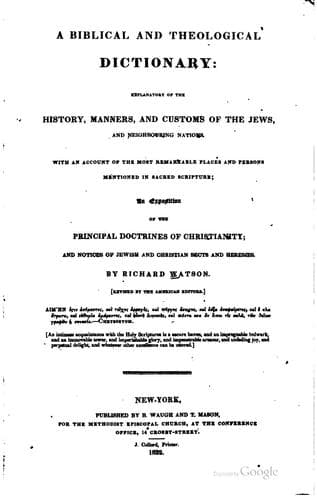
A Biblical and Theological Dictionary: explanatory of the history, manners, and customs of the Jews, and neighbouring nationsWatson, Richard
Religion
A Biblical and Theological Dictionary: explanatory of the history, manners, and customs of the Jews, and neighbouring nations
Watson, Richard
Bible -- Dictionaries; Theology -- Dictionaries
The Persians send a deputation to meet their guests: this deputation are
called openers of the way; and the more distinguished the persons sent,
and the greater the distance to which they go, so much greater is the
honour. So it is proclaimed, “Go forth and behold king Solomon, with the
crown wherewith his mother crowned him.” “The bridegroom cometh, go ye
forth to meet him.” The names of the persons to be invited were
inscribed upon tablets, and the gate was set open to receive those who
had obtained them; but to prevent any getting in that had no ticket,
only one leaf of the door was left open; and that was strictly guarded
by the servants of the family. Those who were admitted had to go along a
narrow passage to the room; and after all who had received tickets of
admission were assembled, the master of the house rose and shut to the
door; and then the entertainment began. The first ceremony, after the
guests arrived at the house of entertainment, was the salutation
performed by the master of the house, or one appointed in his place.
Among the Greeks, this was sometimes done by embracing with arms around;
but the most common salutation was by the conjunction of their right
hands, the right hand being reckoned a pledge of fidelity and
friendship. Sometimes they kissed the lips, hands, knees, or feet, as
the person deserved more or less respect. The Jews welcomed a stranger
to their house in the same way; for our Lord complains to Simon, that he
had given him no kiss, had welcomed him to his table with none of the
accustomed tokens of respect.
The custom of reclining was introduced from the nations of the east, and
particularly from Persia, where it seems to have been adopted at a very
remote period. The Old Testament Scriptures allude to both customs; but
they furnish undeniable proofs of the antiquity of sitting. As this is
undoubtedly the most natural and dignified posture, so it seems to have
been universally adopted by the first generations of men; and it was not
till after the lapse of many ages, and when degenerate man had lost much
of the firmness of his primitive character, that he began to recline.
Public-domain text, read in full here on John Shaqi.
Reviews
Reviews
No reviews yet
Be the first to share your thoughts on this work.
Elsewhere in the archive
Join the Discussion
Join the discussion
Sign in to leave a comment or review.
Sign InorCreate an account